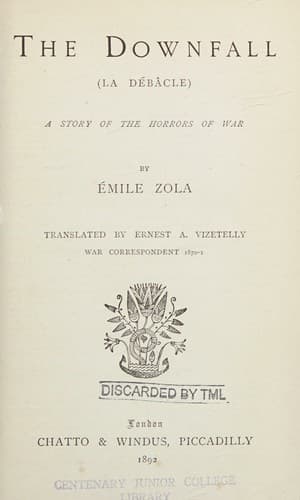
The Downfall (La Débâcle): A Story of the Horrors of WarZola, Émile
General
The Downfall (La Débâcle): A Story of the Horrors of War
Zola, Émile
Franco-Prussian War, 1870-1871 -- Fiction
In the panic-fraught breeze which dishevelled their hair and lashed
their hastily donned garments, many of the runaways looked round with
scared faces, and made gestures with trembling hands as though to shut
out all view of the horizon. Others, farmers, accompanied by all their
servants, were hastening across the fields, driving before them their
herds and flocks--their sheep, cows, oxen and horses, which they had
turned out with blows from their sheds and stables. They were making
for the mountain gorges, the high table-lands, the deserted forests,
and the sight of them recalled the memory of those great migrations
of ancient times, when invaded nations made way for the conquering
barbarians. They intended to live under canvas in some lonely rock-girt
spot, so far from the roads that not one of the enemy's soldiers would
dare to approach it. And the flying clouds that enveloped them were
soon wafted away behind the clumps of fir trees, whilst the lowing of
the cattle and the thuds of their hoofs grew more and more indistinct.
Meantime, the flood of vehicles and wayfarers pressed along the road,
hampering the march of the troops and becoming, as one approached
Belfort, so compact and strong--with a force like the irresistible
current of a spreading torrent--that the soldiers were repeatedly
compelled to halt.
During one of those brief halts Maurice beheld a scene which he long
remembered, as one might remember a blow dealt one in the face. There
was a solitary house by the roadside, the abode of some poor peasant,
whose meagre patch of land stretched behind it. Firmly rooted to
his native soil, this man had been unwilling to leave his fields,
feeling that if he did so he must needs tear his flesh to shreds. So
he remained there, and could be seen crouching on a bench in a low
room, whence with empty eyes he watched the passing soldiers, whose
retreat was about to place his ripe corn at the mercy of the invader.
Beside him stood a young woman, his wife, with a child in her arms,
whilst another child was pulling at her skirts; and all three, mother
and children, were sobbing and moaning. Suddenly, however, the door
was roughly flung open, and on the threshold appeared the grandmother,
a tall, thin, aged woman, who was furiously flourishing her bare arms
which looked like knotted cords. Her grey hair, escaping from under
her cap, was waving round her gaunt head, and so intense was her rage
that the words she shouted were half-stifled in her throat, whence
they escaped but indistinctly in an agonising hiccough. At first the
soldiers began to laugh. The old lunatic had a fine phiz! But some
of her words reached them, and they heard that she was shouting:
'Blackguards! brigands! cowards! cowards!'
In a more and more piercing voice she spat forth, as it were, that
insulting epithet--coward. And then the laughter ceased, and a great
chill sped through the ranks. The men lowered their heads and looked
elsewhere.
'Cowards! cowards! cowards!'
Public-domain text, read in full here on John Shaqi.
Reviews
Reviews
No reviews yet
Be the first to share your thoughts on this work.
Elsewhere in the archive
Join the Discussion
Join the discussion
Sign in to leave a comment or review.
Sign InorCreate an account