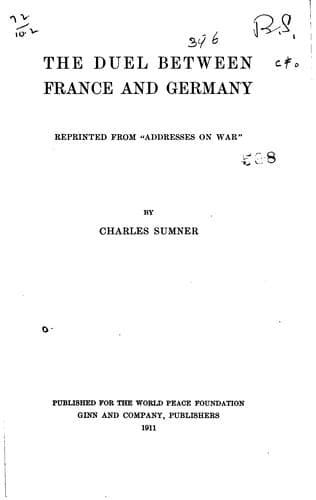
The Duel Between France and GermanySumner, Charles
History
The Duel Between France and Germany
Sumner, Charles
Franco-Prussian War, 1870-1871
The growing tendencies of mankind have been quickened by the
character of the present war, and the unexampled publicity with
which it has been waged. Never before were all nations, even those
separated by great spaces, whether of land or ocean, the daily and
excited spectators of the combat. The vast amphitheatre within
which the battle is fought, with the whole heavens for its roof,
is coextensive with civilization itself. The scene in that great
Flavian Amphitheatre, the famous Colosseum, is a faint type of
what we are witnessing; but that is not without its lesson. Bloody
games, where human beings contended with lions and tigers,
imported for the purpose, or with each other, constituted an
institution of ancient Rome, only mildly rebuked by Cicero,
[Footnote: "Crudele gladiatorum spectaculum et inhumanum nonnullis
videri solet: et hand scio an ita sit, ut nunc fit."_--Tusculanae
Quaestiones_, Lib. II. Cap. XVII. 41.] and adopted even by
Titus, in that short reign so much praised as unspotted by the
blood of the citizen. [Footnote: Suetonius: _Titus_, Cap. IX.
Merivale, History of the Romans under the Empire, (London, 1862,)
Ch. LX., Vol. VII. p. 56.] One hundred thousand spectators looked
on, while gladiators from Germany and Gaul joined in ferocious
combat; and then, as blood began to flow, and victim after victim
sank upon the sand, the people caught the fierce contagion. A
common ferocity ruled the scene. As Christianity prevailed, the
incongruity of such an institution was widely felt; but still it
continued. At last an Eastern monk, moved only by report,
journeyed a long way to protest against the impiety. With noble
enthusiasm he leaped into the arena, where the battle raged, in
order to separate the combatants. He was unsuccessful, and paid
with life the penalty of his humanity. [Footnote: St. Telemachus,
A. D. 401. Gibbon, Decline and Fall of the Roman Empire, ed.
Milman, (London, 1846,) Ch. XXX., Vol. III. p. 70. Smith, Dict.
Gr. and Rom. Biog. and Myth., art. TELEMACHUS.] But the martyr
triumphed where the monk had failed. Shortly afterwards, the
Emperor Honorius, by solemn decree, put an end to this horrid
custom. "The first Christian Emperor," says Gibbon, "may claim the
honor of the first edict which condemned the art and amusement of
shedding human blood." [Footnote: Decline and Fall of the Roman
Empire, _ubi supra_.] Our amphitheatre is larger than that of
Rome; but it witnesses scenes not less revolting; nor need any
monk journey a long way to protest against the impiety. That
protest can be uttered by every one here at home. We are all
spectators; and since by human craft the civilized world has
become one mighty Colosseum, with place for everybody, may we not
insist that the bloody games by which it is yet polluted shall
cease, and that, instead of mutual-murdering gladiators filling
the near-brought scene with death, there shall be a harmonious
people, of different nations, but one fellowship, vying together
Public-domain text, read in full here on John Shaqi.
Reviews
Reviews
No reviews yet
Be the first to share your thoughts on this work.
Elsewhere in the archive
Join the Discussion
Join the discussion
Sign in to leave a comment or review.
Sign InorCreate an account