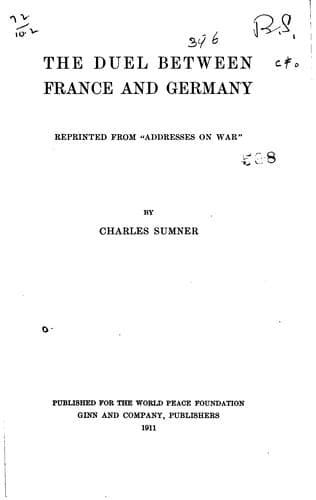
The Duel Between France and GermanySumner, Charles
History
The Duel Between France and Germany
Sumner, Charles
Franco-Prussian War, 1870-1871
As peace is assured, the traditional sensibilities of nations will
disappear. Their frontiers will no longer frown with hostile
cannon, nor will their people be nursed to hate each other. By
ties of constant fellowship will they be interwoven together, no
sudden trumpet waking to arms, no sharp summons disturbing the
uniform repose. By steam, by telegraph, by the press, have they
already conquered time, subdued space,--thus breaking down old
walls of partition by which they have been separated. Ancient
example loses its influence. The prejudices of another generation
are removed, and the old geography gives place to a new. The
heavens are divided into constellations, with names from beasts,
or from some form of brute force,--as Leo, Taurus, Sagittarius,
and Orion with his club; but this is human device. By similar
scheme is the earth divided. But in the sight of God there is one
Human Family without division, where all are equal in rights; and
the attempt to set up distinctions, keeping men asunder, or in
barbarous groups, is a practical denial of that great truth,
religious and political, the Brotherhood of Man. The Christian's
Fatherland is not merely the nation in which he was born, but the
whole earth appointed by the Heavenly Father for his home. In this
Fatherland there can be no place for unfriendly boundaries set up
by any,--least of all, place for the War System, making nations as
hostile camps.
At Lassa, in Thibet, there is a venerable stone in memory of the
treaty between the courts of Thibet and China, as long ago as 821,
bearing an inscription worthy of a true civilization. From Eastern
story learn now the beauty of peace. After the titles of the two
august sovereigns, the monument proceeds: "These two wise, holy,
spiritual, and accomplished princes, foreseeing the changes hidden
in the most distant futurity, touched with sentiments of
compassion towards their people, and not knowing, in their
beneficent protection, any difference between their subjects and
strangers, have, after mature reflection and by mutual consent,
resolved to give peace to their people... In perfect harmony with
each other, they will henceforth be good neighbors, and will do
their utmost to draw still closer the bonds of union and
friendship. Henceforward the two empires of Han (China) and Pho
(Thibet) shall have fixed boundaries... In preserving these
limits, the respective parties shall not endeavor to injure each
other; they shall not attack each other in arms, or make any more
incursions beyond the frontiers now determined." Then declaring
that the two "must reciprocally exalt their virtues and banish
forever all mistrust between them, that travellers may be without
uneasiness, that the inhabitants of the villages and fields may
live at peace, and that nothing may happen to cause a misunderstanding,"
the inscription announces, in terms doubtless Oriental: "This
benefit will be extended to future generations, and the voice
Public-domain text, read in full here on John Shaqi.
Reviews
Reviews
No reviews yet
Be the first to share your thoughts on this work.
Elsewhere in the archive
Join the Discussion
Join the discussion
Sign in to leave a comment or review.
Sign InorCreate an account