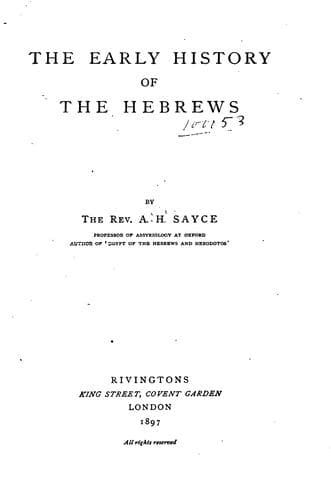
The early history of the HebrewsSayce, A. H. (Archibald Henry)
History
The early history of the Hebrews
Sayce, A. H. (Archibald Henry)
Bible. Old Testament -- Criticism, interpretation, etc.; Jews -- History -- To 953 B.C.
It is only fragments of the life of Abraham that are brought before us
in the pages of Genesis. They are like a series of pictures which have
been saved from the shipwreck of the past. And the pictures are not
always painted in the same colours. At one time the patriarch appears as
‘a mighty prince,’ as a rich and cultured Chaldæan immigrant, with armed
bands of warriors under him with whom he can venture to attack even the
army of the king of Elam. He is the confederate of the Amorite
chieftains, the prince whom the Hittites of Hebron hear with respect.
But at another time the colours on the canvas seem quite different. When
the angels warn the patriarch of the approaching overthrow of the cities
of the plain, they find him in the tent of a Bedâwi, leading the simple
life of an uncultured nomad, and preparing the food of his guests with
his own hands. Between this Bedâwi shêkh and the companion of the king
of Gerar or the Pharaoh of Egypt the contrast is indeed great.
To the Western mind, however, the contrast is greater than it would be
to the Oriental. The traveller in the East is well acquainted with
wealthy Bedâwin shêkhs who live in the desert in barbaric simplicity,
but, nevertheless, have their houses at Cairo or Damascus, where they
indulge in all the luxury and splendour of Oriental life. Moreover, the
narratives which have been combined in the book of Genesis do not all
come from the same source. Some of them have been taken from written
historical documents which breathe the atmosphere of the cultured city,
of the educated scribe, and the luxurious court. Others, derived it may
be from oral tradition, are filled with the spirit of the wanderer in
the desert, and set before us the simple life and rude fare of the
dweller in tents. The history of the patriarchs is, in fact, like
Joseph’s coat of many colours. It is a series of pictures rather than a
homogeneous whole. The materials of which it is composed differ widely
in both character and origin. Some of them can be shown to have been
contemporaneous with the events they record; some again to have been
like the tales of their old heroes recounted by the nomad Arabs in the
days before Islam as they sat at night round their camp-fires. The
details and spirit of the story have necessarily caught the colour of
the medium through which they have passed. The life of Abraham,
doubtless, presented the contrasts still presented by that of a rich
Bedâwi shêkh; at one time spent in the wild freedom and privations of
the desert; at another amid the luxuries and culture of the town; but
the contrasts have been heightened by the difference in the sources
through which they have been handed down. Naturally, while the scribe
would record only those phases of Abraham’s history which brought him
into contact with the great world of kings and princes, of war and
trade, the nomad reciter of ancient stories would dwell rather on such
parts of it as he and his hearers could understand. For them Abraham
Public-domain text, read in full here on John Shaqi.
Reviews
Reviews
No reviews yet
Be the first to share your thoughts on this work.
Join the Discussion
Join the discussion
Sign in to leave a comment or review.
Sign InorCreate an account