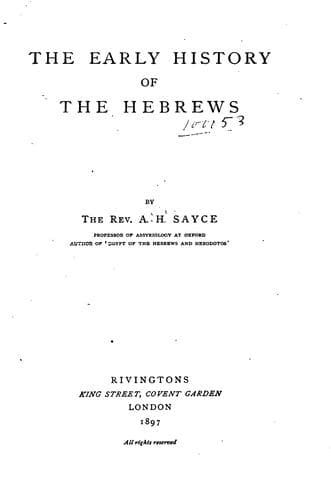
The early history of the HebrewsSayce, A. H. (Archibald Henry)
History
The early history of the Hebrews
Sayce, A. H. (Archibald Henry)
Bible. Old Testament -- Criticism, interpretation, etc.; Jews -- History -- To 953 B.C.
would become a desert-wanderer like themselves.
This difference in the sources of the narrative explains why it is that
the figure of Abraham so largely overshadows that of his son Isaac.
Isaac seems almost swallowed up in that darkness of antiquity through
which the figure of his father looms so largely. Apart from his dispute
with Abimelech of Gerar, which reads like a repetition of the dispute
between Abimelech and Abraham, there is little told of the life of Isaac
which is not connected with his more famous father or son. Between
Abraham and Jacob, the great ancestors of Israel, Isaac seems to
intervene as merely a connecting link.
But the life of Isaac was that of a Bedâwi shêkh. The other side of his
father’s life and character was lost. The forefather of Israel had
ceased to be a Chaldæan, and had become simply a dweller in the desert,
like the fugitive slaves from Egypt in after days. Even Hebron was left,
and the life of Isaac was mainly passed on the northern edge of that
desert in which his descendants were in later times to receive the Law.
If he approached Canaan, it was only to Beer-sheba and Gerar on the
southern skirts of Canaanitish territory, where the Bedâwin and their
flocks still claimed to be masters. But his chief residence was further
south, in the very heart of the wilderness.
Isaac was thus essentially a Bedâwi, a fit type of the phase of life
through which the Israelites were destined to pass before their conquest
of the Promised Land. With the politics and trade of the civilised
world, accordingly, he never came into contact. There was nothing in his
existence for the historian to chronicle; nothing which could bring his
name into the written history of the time. If his memory were to be
preserved at all, it could be only through the unwritten traditions of
the desert, through the tales told of him among the desert tribes.
Once indeed, it is said, he had relations with a king. The king was one
of those Canaanitish princelets with whose names the Tel el-Amarna
tablets are filled. The dominions of Abimelech of Gerar were of small
extent, and must have been barren in the extreme. The site of Gerar lies
two hours south of Gaza,[74] and the territory of its king extended
eastward as far as Beer-sheba. It was essentially a desert territory:
during the greater part of the year the whole country is bare and
sterile; only after rain does the wilderness break forth suddenly into
green herbage.
Public-domain text, read in full here on John Shaqi.
Reviews
Reviews
No reviews yet
Be the first to share your thoughts on this work.
Join the Discussion
Join the discussion
Sign in to leave a comment or review.
Sign InorCreate an account