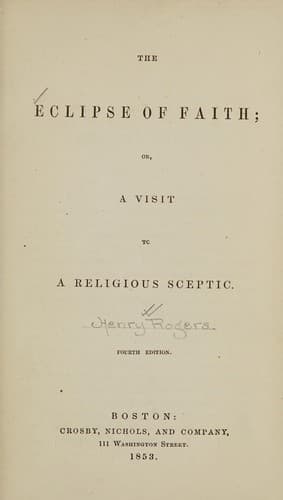
The Eclipse of Faith; Or, A Visit to a Religious ScepticRogers, Henry
Religion
The Eclipse of Faith; Or, A Visit to a Religious Sceptic
Rogers, Henry
Skepticism -- Controversial literature
"Whatever he says, I suppose you will not deny that they are
conceivable; and that is all I am thinking of at present. Their
impossibility or possibility I will not dispute with you just now.
I am disposed to with you; only, as usual, I have some doubts, which
I wish you would endeavor to solve; but of that another time. Meantime,
my good friend, be so obliging as to give me an answer to my
question,--whether you would deem it to be your duty to reject any
such claims to authoritative teaching, even if backed by the
performance of miracles? for, admitting miracles never to have
occurred, and even that they never will, you, I think, would hesitate
to affirm that you clearly perceive that the very notion involves a
contradiction. They are, at least, imaginable, and that is sufficient
to supply you with an answer to my question. I once more ask you,
therefore, whether, if such a teacher of a book-revelation, in the
comprehensive sense of these words already defined, were to authenticate
(as he affirmed) his claims to reverence by any number, variety, or
splendor of miracles,--undoubted miracles,--you would any the more feel
bound to believe him?"
"What! upon the supposition that there was any thing morally
objectionable in his doctrine?"
"I will release you on that score too." said Harrington, in a most
accommodating manner. "Morally, I will assume there is nothing in his
doctrine but what you approve; and as for the rest,--to confirm which
I will suppose the revelation given,--I will assume nothing in it
which you could demonstrate to be false or contradictory; in fact,
nothing more difficult to be believed than many undeniable phenomena of
the external universe,--matters, for example, which you acknowledge you
do not comprehend, but which may possibly be true for aught you can
tell to the contrary."
"But if the supposed revelation contain nothing but what, appealing
thus to my judgment, I can approve, where is the necessity of a
revelation at all?"
"Did I say, my friend, that it was to contain nothing but what is
referred to your judgment? nothing but what you would know and approve
just as well without it? or even did I concede that you could have
known and approved without it that which, when it is proposed, you do
approve? I simply wish an answer to the question, whether, if a teacher
of an ethical system such as you entirely approved, with some doctrines
attached, incomprehensible it may be, but not demonstratively false or
immoral, were to substantiate (as he affirmed) his claims to your
belief by the performance of miracles, you would or would not feel
constrained any the more to believe him?"
"But I do not see the use of discussing a question under circumstances
which it is admitted never did nor ever can occur?"
Public-domain text, read in full here on John Shaqi.
Reviews
Reviews
No reviews yet
Be the first to share your thoughts on this work.
Elsewhere in the archive
Join the Discussion
Join the discussion
Sign in to leave a comment or review.
Sign InorCreate an account