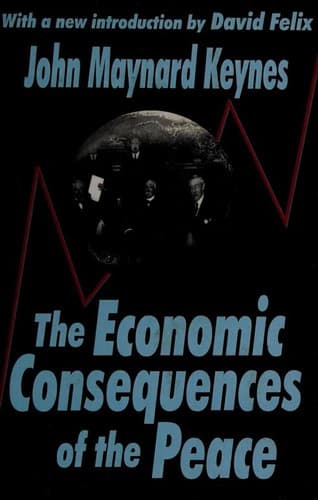
The Economic Consequences of the PeaceKeynes, John Maynard
History
The Economic Consequences of the Peace
Keynes, John Maynard
Economic history -- 1918-1945; Treaty of Versailles (1919 June 28); World War, 1914-1918 -- Economic aspects
[38] "We take over the ownership of the Sarre mines, and in
order not to be inconvenienced in the exploitation of these coal
deposits, we constitute a distinct little estate for the 600,000 Germans
who inhabit this coal basin, and in fifteen years we shall endeavor by a
plebiscite to bring them to declare that they want to be French. We know
what that means. During fifteen years we are going to work on them, to
attack them from every point, till we obtain from them a declaration of
love. It is evidently a less brutal proceeding than the _coup de force_
which detached from us our Alsatians and Lorrainers. But if less brutal,
it is more hypocritical. We know quite well between ourselves that it is
an attempt to annex these 600,000 Germans. One can understand very well
the reasons of an economic nature which have led Clemenceau to wish to
give us these Sarre coal deposits, but in order to acquire them must we
give ourselves the appearance of wanting to juggle with 600,000 Germans
in order to make Frenchmen of them in fifteen years?" (M. HervÈ in _La
Victorie_, May 31, 1919).
[39] This plebiscite is the most important of the concessions
accorded to Germany in the Allies' Final Note, and one for which Mr.
Lloyd George, who never approved the Allies' policy on the Eastern
frontiers of Germany, can claim the chief credit. The vote cannot take
place before the spring of 1920, and may be postponed until 1921. In the
meantime the province will be governed by an Allied Commission. The vote
will be taken by communes, and the final frontiers will be determined by
the Allies, who shall have regard, partly to the results of the vote in
each commune, and partly "to the geographical and economic conditions of
the locality." It would require great local knowledge to predict the
result. By voting Polish, a locality can escape liability for the
indemnity, and for the crushing taxation consequent on voting German, a
factor not to be neglected. On the other hand, the bankruptcy and
incompetence of the new Polish State might deter those who were disposed
to vote on economic rather than on racial grounds. It has also been
stated that the conditions of life in such matters as sanitation and
social legislation are incomparably better in Upper Silesia than in the
adjacent districts of Poland, where similar legislation is in its
infancy. The argument in the text assumes that Upper Silesia will cease
to be German. But much may happen in a year, and the assumption is not
certain. To the extent that it proves erroneous the conclusions must be
modified.
[40] German authorities claim, not without contradiction, that
to judge from the votes cast at elections, one-third of the population
would elect in the Polish interest, and two-thirds in the German.
Public-domain text, read in full here on John Shaqi.
Reviews
Reviews
No reviews yet
Be the first to share your thoughts on this work.
Elsewhere in the archive
Join the Discussion
Join the discussion
Sign in to leave a comment or review.
Sign InorCreate an account