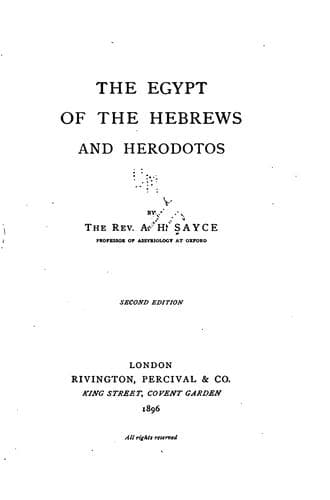
The Egypt of the Hebrews and HerodotosSayce, A. H. (Archibald Henry)
History
The Egypt of the Hebrews and Herodotos
Sayce, A. H. (Archibald Henry)
Egypt -- History, Ancient
If Ramses II. was the Pharaoh of the Oppression, the Pharaoh of the Exodus
must have been one of his immediate successors. Egyptologists have
hesitated between Meneptah, Seti II., and Si-Ptah. There is much to be
said in favour of each. None of them reigned long, and after the death of
Meneptah the sceptre fell into feeble hands, and the Egyptian monarchy
went rapidly to decay.
Native tradition, as reported by the historian Manetho, made Meneptah the
Pharaoh under whom the children of Israel escaped from their house of
bondage. Amenôphis or Meneptah, it was said, desired to see the gods. He
was accordingly instructed by the seer Amenôphis, the son of Pa-apis, to
clear the land of the leprous and impure. This he did, and 80,000 persons
were collected from all parts of Egypt, and were then separated from the
other inhabitants of the country and compelled to work in the quarries of
Tûra, on the eastern side of the Nile. Among them there happened to be
some priests, one of whom was Osarsiph, a priest of On, and the
sacrilegious act of laying hands on them was destined to be avenged by the
gods. The seer prophesied that the impure lepers would find allies, and
with their help would govern Egypt for thirteen years, when a saviour
should arise in the person of Amenôphis himself. Not daring to tell the
king of this prediction, he put it in writing and then took away his own
life. After a time the workers in the quarries were removed to Avaris, the
deserted fortress of the Hyksos, on the Asiatic frontier of the Egyptian
kingdom. Here they rose in rebellion under Osarsiph, who organised them
into a community, and gave them new laws, forbidding them to revere the
sacred animals, and ordering them to rebuild the walls of Avaris. He also
sent to the descendants of the Hyksos at Jerusalem, begging for their
assistance. A force of 200,000 men was accordingly despatched to Avaris,
and the invasion of Egypt decided on. Amenôphis retired into Ethiopia
without striking a blow, carrying with him his son Sethos, who was also
called Ramesses after his grandfather, as well as the sacred bull Apis,
and other holy animals. The images of the gods were concealed, lest they
should be profaned by the invaders. Amenôphis remained in Ethiopia for
thirteen years, while Osarsiph, who had taken the name of Moses, together
with his allies from Jerusalem, committed innumerable atrocities. At last,
however, Amenôphis and his son Sethos returned, each at the head of an
army; the enemy were defeated and overthrown, and finally pursued to the
borders of Syria.
Public-domain text, read in full here on John Shaqi.
Reviews
Reviews
No reviews yet
Be the first to share your thoughts on this work.
Join the Discussion
Join the discussion
Sign in to leave a comment or review.
Sign InorCreate an account