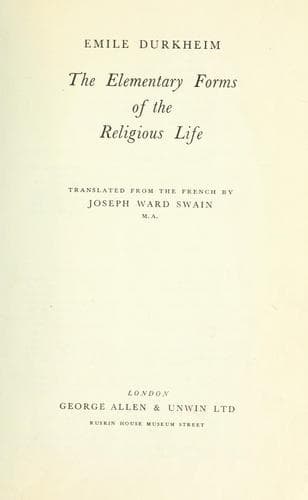
The Elementary Forms of the Religious LifeDurkheim, Émile
Religion
The Elementary Forms of the Religious Life
Durkheim, Émile
Cults; Religion; Religion -- Philosophy; Rites and ceremonies; Totemism
Howsoever rudimentary his intelligence may be, how could
a man on awakening believe that he had really been assisting at or
taking part in events which he knows passed long before? How could he
imagine that during his sleep he lived a life which he knows has long
since gone by? It would be much more natural that he should regard these
renewed images as merely what they really are, that is, as souvenirs
like those which he has during the day, but ones of a special intensity.
Moreover, in the scenes of which we are the actors and witnesses while
we sleep, it constantly happens that one of our contemporaries has a
rôle as well as ourselves: we think we see and hear him in the same
place where we see ourselves. According to the animists, the primitive
would explain this by imagining that his double was visited by or met
with those of certain of his companions. But it would be enough that on
awakening he question them, to find that their experiences do not
coincide with his. During this same time, they too have had dreams, but
wholly different ones. They have not seen themselves participating in
the same scene; they believe that they have visited wholly different
places. Since such contradictions should be the rule in these cases, why
should they not lead men to believe that there had probably been an
error, that they had merely imagined it, that they had been duped by
illusions? This blind credulity which is attributed to the primitive is
really too simple. It is not true that he must objectify all his
sensations. He cannot live long without perceiving that even when awake
his senses sometimes deceive him. Then why should he believe them more
infallible at night than during the day? Thus we find that there are
many reasons opposing the theory that he takes his dreams for the
reality and interprets them by means of a double of himself.
Public-domain text, read in full here on John Shaqi.
Reviews
Reviews
No reviews yet
Be the first to share your thoughts on this work.
Join the Discussion
Join the discussion
Sign in to leave a comment or review.
Sign InorCreate an account