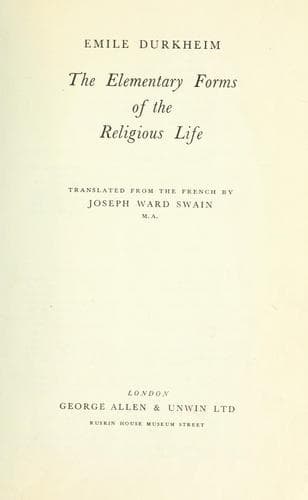
The Elementary Forms of the Religious LifeDurkheim, Émile
Religion
The Elementary Forms of the Religious Life
Durkheim, Émile
Cults; Religion; Religion -- Philosophy; Rites and ceremonies; Totemism
Thus all tends to show that, in spite of the credit it still enjoys, the
animistic theory of the soul must be revised. It is true that to-day the
primitive attributes his dreams, or at least certain of them, to
displacements of his double. But that does not say that the dream
actually furnished the materials out of which the idea of the double or
the soul was first constructed; it might have been applied afterwards to
the phenomena of dreams, ecstasy and possession, without having been
derived from them. It is very frequent that, after it has been formed,
an idea is employed to co-ordinate or illuminate--with a light
frequently more apparent than real--certain facts with which it had no
relation at first, and which would never have suggested it themselves.
God and the immortality of the soul are frequently proven to-day by
showing that these beliefs are implied in the fundamental principles of
morality; as a matter of fact, they have quite another origin. The
history of religious thought could furnish numerous examples of these
retrospective justifications, which can teach us nothing of the way in
which the ideas were formed, nor of the elements out of which they are
composed.
It is also probable that the primitive distinguishes between his dreams,
and does not interpret them all in the same way. In our European
societies the still numerous persons for whom sleep is a sort of
magico-religious state in which the mind, being partially relieved of
the body, has a sharpness of vision which it does not enjoy during
waking moments, do not go to the point of considering all their dreams
as so many mystic intuitions: on the contrary, along with everybody
else, they see in the majority of their dreams only profane conditions,
vain plays of images, or simple hallucinations. It might be supposed
that the primitive should make analogous distinctions. Codrington says
distinctly that the Melanesians do not attribute all their dreams
indiscriminately to the wanderings of their souls, but merely those
which strike their imagination forcibly:[109] undoubtedly by that should
be understood those in which the sleeper imagines himself in relations
with religious beings, good or evil geniuses, souls of the dead, etc.
Similarly, the Dieri in Australia sharply distinguish ordinary dreams
from those nocturnal visions in which some deceased friend or relative
shows himself to them. In the first, they see a simple fantasy of their
imagination; they attribute the second to the action of an evil
spirit.[110] All the facts which Howitt mentions as examples to show how
the Australian attributes to the soul the power of leaving the body,
have an equally mystic character. The sleeper believes himself
transported into the land of the dead or else he converses with a dead
companion.[111] These dreams are frequent among the primitives.[112] It
is probably upon these facts that the theory is based. To account for
Public-domain text, read in full here on John Shaqi.
Reviews
Reviews
No reviews yet
Be the first to share your thoughts on this work.
Elsewhere in the archive
Join the Discussion
Join the discussion
Sign in to leave a comment or review.
Sign InorCreate an account