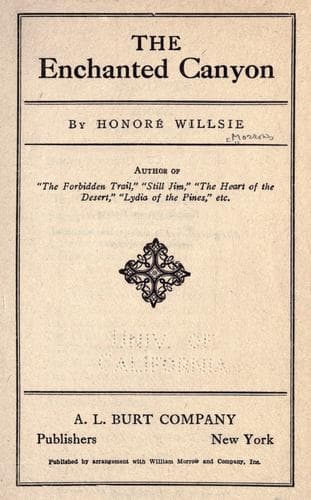
Arizona -- Fiction; Grand Canyon (Ariz.) -- Fiction; Western stories
"Well, no--we'll consider that the luncheon and this dinner square the
Johnstown pinching, perhaps a trifle more. What I wanted to say was
that it struck me as worth comment that after you ceased being Police
Commissioner, you never again talked of the impoverished boyhood of
America. And yet you were a very successful Commissioner, were you
not?"
Enoch looked from Diana out over the balcony rail to the fountain that
twinkled in the little park.
"One of the most difficult things in public life," he said slowly, "is
to hew straight to the line one laid out at the beginning."
"I should think," Diana suggested, "that the difficulty would depend on
what the line was. A man who goes into politics to make himself rich,
for example, might easily stick to his original purpose."
"Exactly! But money of itself never interested me!" Here Enoch
stopped with a quick breath. There flashed across his inward vision
the picture of a boy in Luigi's second story, throwing dice with
passionate intensity. Enoch took a long sip of water, then went on.
"I wanted to be Police Commissioner of New York because I wanted to
make it impossible for other boys to have a boyhood like mine. I don't
mean that, quite literally, I thought one man or one generation could
accomplish the feat. But I did truly think I could make a beginning.
Miss Allen, in spite of the beautiful fights I had, in spite of the
spectacular clean-ups we made, I did nothing for the boys that my
successor did not wipe out with a single stroke of his pen, his first
week in office."
Diana drew a long breath. "I wonder why," she said.
"I think that lack of imagination, poor memory, personal selfishness,
is the answer. There is nothing people forget quite so quickly as the
griefs of their own childhood. There is nothing more difficult for
people to imagine than how things affect a child's mind. And yet,
nothing is so important in America to-day as the right kind of
education for boys. It has not been found as yet."
"Have you a theory about it?" asked Diana.
"Yes, I have. Have you?"
Diana nodded. "I don't think boys and girls should be educated from
the same angle."
"No? Why not?" Enoch's blue eyes were eager.
"Wandering about the desert among the Indians, one has leisure to think
and to observe the workings of life under frank and simple conditions.
It has seemed to me that the boy approaches life from an entirely
different direction from a girl and that our system of education should
recognize that. Both are primarily guided by sex, their femaleness or
their maleness is always their impelling force. I'm talking now on the
matter of the spiritual and moral training, not book education."
"Why not include the mental training? I think you'd be quite right in
doing so."
"Perhaps so," replied Diana.
Public-domain text, read in full here on John Shaqi.
Reviews
Reviews
No reviews yet
Be the first to share your thoughts on this work.
Elsewhere in the archive
Join the Discussion
Join the discussion
Sign in to leave a comment or review.
Sign InorCreate an account