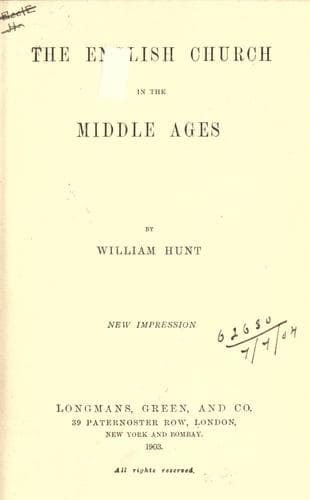
The English Church in the Middle AgesHunt, William
History
The English Church in the Middle Ages
Hunt, William
Church history -- Middle Ages, 600-1500; Great Britain -- Church history
No writ was issued for the consecration of Thomas of York until Lanfranc
had received consecration, and this delay was perhaps intentional; for
when Thomas brought the writ to Lanfranc he was bidden to profess
obedience to the see of Canterbury. He refused to do so, on the ground
that Gregory had instituted two co-ordinate archbishoprics. On the other
hand, the bishops of York, from Paulinus to Ecgberht, had not enjoyed
metropolitan dignity, and even since Ecgberht's time the see had occupied
an inferior position to Canterbury. Lanfranc had papal decrees and other
evidences on his side, and gained the king's support by representing that
an independent metropolitan at York might crown an independent king of
Northumbria. William compelled Thomas to profess obedience to Lanfranc
personally, and, with respect to the future, ordered that the question
should be decided by the Pope. When the two archbishops went to Rome for
their palls, Alexander was about to degrade Thomas and Remigius, bishop of
Dorchester, who went with them, on account of canonical irregularity, and
only forbore to do so at Lanfranc's request. Thomas brought forward the
matter of the profession, and further claimed Dorchester, Lichfield, and
Worcester as subject to York. Alexander referred these matters to the
decision of an English synod, and the case seems to have been heard before
a mixed assembly of clergy and laity, which pronounced against Thomas; he
was forced to make a general profession of obedience, the Humber was
declared the boundary between the provinces, and he was left with only one
suffragan, the bishop of Durham. This disproportion between the
archbishoprics had not been contemplated by Gregory, for his division,
which was based on the assumption that the whole island was under one
rule, included Scotland in the province of York. Under William and
Lanfranc the English Church made its power felt in yet unconquered Celtic
lands. The claim of York was asserted over Scotland. As that country had
no metropolitan and no organized episcopal system, the assertion was
plausible, and a bishop of the Orkneys was certainly consecrated by
Thomas. It is extremely doubtful whether the authority of Canterbury was
in any instance acknowledged in Wales during this reign, though a few
years later it was, as we shall see, successfully asserted. In Ireland the
irregular condition of the episcopacy naturally led kings and bishops to
look up to Lanfranc; he consecrated two archbishops of Dublin, who made
profession to him, and he wrote with authority to two kings on matters of
discipline. An approach was thus made to the ecclesiastical submission of
Ireland, and the primate of Britain was not unreasonably held by Latin
Christendom to be "Patriarch of the nations beyond the sea."
[Sidenote: National synods and ecclesiastical courts.]
Public-domain text, read in full here on John Shaqi.
Reviews
Reviews
No reviews yet
Be the first to share your thoughts on this work.
Elsewhere in the archive
Join the Discussion
Join the discussion
Sign in to leave a comment or review.
Sign InorCreate an account