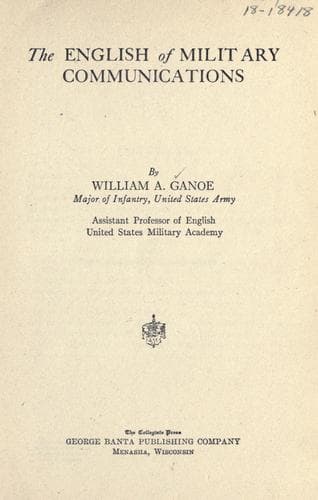
The English of military communicationsGanoe, William Addleman
History
The English of military communications
Ganoe, William Addleman
English language -- Rhetoric; Military orders; United States. Army -- Records and correspondence
There is no error in the expressiveness of a field order which the
analytical and synthetical study of English will not overcome. We
must first learn by analysis to recognize mistakes when we see them.
We must then try to manipulate our language so that those mistakes
will not occur. Indeed, we must go further than the mere negative
avoidance of mistakes. We must not be satisfied until we have made
our expressions exert a positive force. The ways and means of so
doing are found in the simple rules of rhetoric.
It is, perhaps, not too much to say that the American works against
heavier odds than the European. The syntax of the inflected
languages of Europe demands that the speaker pay a proper attention
to the changes of number, gender, and case, if he would not appear
ridiculous, whereas the English language, being almost without
inflections, permits its speaker to toss his words about with an
ease unknown to Continental speech, and still be intelligible. The
result is that the European is trained to more care, and, therefore,
greater exactness, than is demanded of the American. Moreover, the
average American’s commercial education does not include a careful,
analytical study of an inflected language. His geographical aloofness
from the rest of the world insures him also a linguistic isolation.
The European, on the other hand, has an added advantage in that by
traversing a territory no larger than three or four of our big
states, he will encounter a half-dozen languages, of all of which he
must have some knowledge if he is to be a financial success.
The American, then, in writing orders is competing against a
handicap. Von Kiessing, a foreigner, states that “the best of plans,
the most skilful combinations, may fail, if the commander or his
staff officers cannot express them properly”; and Buddecke, also a
foreigner, insists that “a plan, promising success, may fail if it
does not find correct expression in an order.” If these men, schooled
in language as well as in tactics, find admonition so emphatically
necessary, how must we look upon the matter?
The form and composition of the order, if practiced now, ought to
give us a certain amount of independence when we come to practical
and strategical considerations later. For certainly, we shall be far
ahead of our fellows who must try at once, and for the first time,
both tactics and composition.
THE FORM OF THE FIELD ORDER
“To enable the will of the commander to be quickly understood, to
secure prompt cooperation among his subordinates, and for ready
reference, field orders are required to follow a general form. This
form divides an order into sections or parts and assigns to each a
particular class of information.
The parts of the field order are:
THE HEADING.
THE DISTRIBUTION OF TROOPS (in certain orders).
THE BODY.
THE ENDING.”[9]
Public-domain text, read in full here on John Shaqi.
Reviews
Reviews
No reviews yet
Be the first to share your thoughts on this work.
Join the Discussion
Join the discussion
Sign in to leave a comment or review.
Sign InorCreate an account