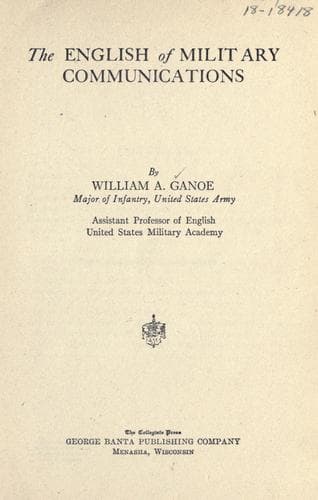
The English of military communicationsGanoe, William Addleman
History
The English of military communications
Ganoe, William Addleman
English language -- Rhetoric; Military orders; United States. Army -- Records and correspondence
To give this plan expression is the purpose of the field order.
Certainly if the decision is clear and simple, the translation
into language ought to be easy. Infantry Drill Regulations state:
“Ambiguity or vagueness indicates either vacillation or inability
to formulate orders.” Since vacillation is a matter of character,
the discussion of such a trait is outside of this course; but the
inability to formulate orders is not. In fact it belongs only in
the course of Rhetoric or English. The following terms are found in
our Regulations and Text Books: “Clear and concise instructions are
given as to the action to be taken in combat”;[5] “an order must
be definite and the expression of a fixed decision”;[5] “field
orders are brief”;[6] “field orders must be brief and definite”;[6]
“clear and decisive orders are the logical result of definite and
sure decisions and are the means of transforming the decision into
action”;[6] “Make your order short and make it definite”;[7] “above
all do not give vague orders”;[7] “be positive and definite”;[7]
“a plan, promising success, may fail if it does not find correct
expression in an order.”[8] And so our manuals keep on telling us
to use correct English, but failing to tell us how. Putting the
clarified decision into the form of an order is the business of
Rhetoric. And the process requires the application of every rule for
correct English we have learned or are going to learn.
“_Often a faulty expression, a word too much or too little, or an
omission, may become the source of serious consequences_,” declares
Buddecke. Even in the orders of the greatest commanders, a twist of
phrase or a wrong word has given an unintentional meaning, so that
troops have from the very construction of the order acted contrary to
the will of the chief. Napoleon, in a despatch to Davout before the
battles of Auerstadt and Jena, stated: “If the Prince of Portecorvo
(Bernadotte) is with you, you may march together; but the Emperor
hopes that he will be already in the position assigned him at
Dornberg.” Bernadotte, as it happened, had not gone to Dornberg. He
was with Davout. He determined, from the last clause of the order and
from the word “may,” that Napoleon desired him to be at Dornberg. To
Dornberg he marched, and there he calmly waited within sound of the
guns, while the battles of Auerstadt and Jena were fought. He was
useless both to Napoleon and to Davout. Indeed, he was seriously
needed by Davout who, with 27,000 was opposed to 51,000 Prussians.
Yet the error is attributable not to Bernadotte but to Napoleon, who
meant to say, “You should march together; but the Emperor hopes that
he has arrived,” etc. Napoleon for once did not say what he meant. It
is likely we may be found more wanting in this regard.
Public-domain text, read in full here on John Shaqi.
Reviews
Reviews
No reviews yet
Be the first to share your thoughts on this work.
Join the Discussion
Join the discussion
Sign in to leave a comment or review.
Sign InorCreate an account