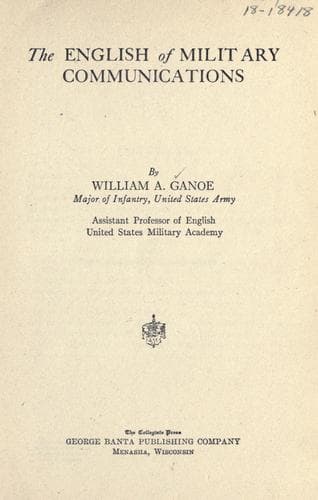
The English of military communicationsGanoe, William Addleman
History
The English of military communications
Ganoe, William Addleman
English language -- Rhetoric; Military orders; United States. Army -- Records and correspondence
THE BODY.—The Body, of course, is the main part of the order. It
contains the information and instructions for the command. It is to
this part that Buddecke refers when he says: “_The order, which is to
transform decision into action, is of the utmost importance._”
The Sentence and the Paragraph, then, should be perfectly
constructed. Each one of those elements should be tested to see
that it is unified, coherent, and emphatic. _The examples herein
given, or any set phrasing, should never be imitated._ Every leader
must compose his own words, his own decision. He must give to his
subordinates the language that best suits the particular occasion.
Otherwise there will be no unity of structure and little likelihood
of unity of action. Every military situation is a a law unto itself,
and the language of the field order should fit that law.
Nevertheless there are certain aids, as we shall see, in composing
_the Body_. The topic of each paragraph is to be found in our
Regulations. We must see that nothing enters the paragraph or
sub-paragraph but that which belongs in the topic assigned. We must
see, also, that all of the matter belonging in a paragraph is
placed there, and that every sentence in the paragraph is free from
violations of Unity, Coherence, and Emphasis.
“Paragraph 1 contains such information of the enemy and of our
supporting troops as it is desirable that subordinates should know.”
“Paragraph 2 contains the general plan of the commander, or so much
thereof as will insure cooperation of all parts of the command.”
“Paragraph 3 contains the detailed tactical dispositions adopted
by the commander to carry out the plan outlined in paragraph 2,
including the tasks assigned to each of the several combatant
fractions of the command. These tasks are given under lettered
subheads (a), (b), etc., the leading fraction, or the one having the
most important duty to perform, being generally considered first.
For instance: In an attack order it is customary to consider the
artillery first; in a march order troops are considered according to
their position in column.”
“Instructions applicable to all of these fractions may be embodied in
a sub-paragraph, letter (X), at the end of paragraph 3.”
“Paragraph 4 contains instructions for the trains, and may designate
the position of ammunition distributing stations, dressing stations,
and stations for slightly wounded.”
“The last paragraph, usually paragraph 5, shows where the commander
can be found or messages may be sent. In orders of subordinate
commanders, this paragraph also gives the location of lines of
information, if any have been established.”
“If additional paragraphs are necessary, they are incorporated,
properly numbered, after paragraph 4. Sometimes it is unnecessary
to include instructions for the trains; but whatever the number of
paragraphs the last always shows where the commander can be found,
etc.”[11]
Briefly, then, the paragraphs may be epitomized as follows:
Public-domain text, read in full here on John Shaqi.
Reviews
Reviews
No reviews yet
Be the first to share your thoughts on this work.
Join the Discussion
Join the discussion
Sign in to leave a comment or review.
Sign InorCreate an account