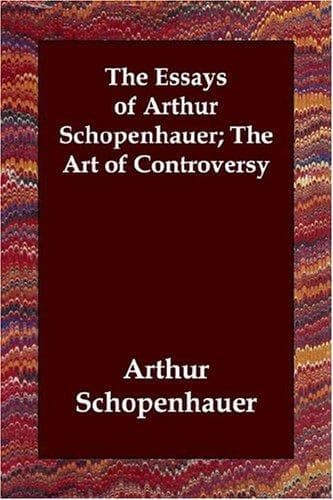
The Essays of Arthur Schopenhauer; the Art of ControversySchopenhauer, Arthur
Philosophy
The Essays of Arthur Schopenhauer; the Art of Controversy
Schopenhauer, Arthur
Debates and debating; Logic
That a man shall attain this inner unity is the impossible and
inconsistent pretension put forward by almost all philosophers.[1] For
as a man it is natural to him to be at war with himself as long as
he lives. While he can be only one thing thoroughly, he has the
disposition to be everything else, and the inalienable possibility
of being it. If he has made his choice of one thing, all the other
possibilities are always open to him, and are constantly claiming to
be realised; and he has therefore to be continuously keeping them
back, and to be overpowering and killing them as long as he wants to
be that one thing. For example, if he wants to think only, and not
act and do business, the disposition to the latter is not thereby
destroyed all at once; but as long as the thinker lives, he has every
hour to keep on killing the acting and pushing man that is within him;
always battling with himself, as though he were a monster whose head
is no sooner struck off than it grows again. In the same way, if he is
resolved to be a saint, he must kill himself so far as he is a being
that enjoys and is given over to pleasure; for such he remains as long
as he lives. It is not once for all that he must kill himself: he
must keep on doing it all his life. If he has resolved upon pleasure,
whatever be the way in which it is to be obtained, his lifelong
struggle is with a being that desires to be pure and free and holy;
for the disposition remains, and he has to kill it every hour. And so
on in everything, with infinite modifications; it is now one side of
him, and now the other, that conquers; he himself is the battlefield.
If one side of him is continually conquering, the other is continually
struggling; for its life is bound up with his own, and, as a man, he
is the possibility of many contradictions.
[Footnote 1: _Audacter licet profitearis, summum bonum esse anímí
concordian_.--Seneca.]
How is inner unity even possible under such circumstances? It exists
neither in the saint nor in the sinner; or rather, the truth is that
no man is wholly one or the other. For it is _men_ they have to be;
that is, luckless beings, fighters and gladiators in the arena of
life.
To be sure, the best thing he can do is to recognise which part of him
smarts the most under defeat, and let it always gain the victory. This
he will always be able to do by the use of his reason, which is an
ever-present fund of ideas. Let him resolve of his own free will to
undergo the pain which the defeat of the other part involves. This
is _character_. For the battle of life cannot be waged free from all
pain; it cannot come to an end without bloodshed; and in any case
a man must suffer pain, for he is the conquered as well as the
conqueror. _Haec est vivendi conditio_.
* * * * *
Public-domain text, read in full here on John Shaqi.
Reviews
Reviews
No reviews yet
Be the first to share your thoughts on this work.
Join the Discussion
Join the discussion
Sign in to leave a comment or review.
Sign InorCreate an account