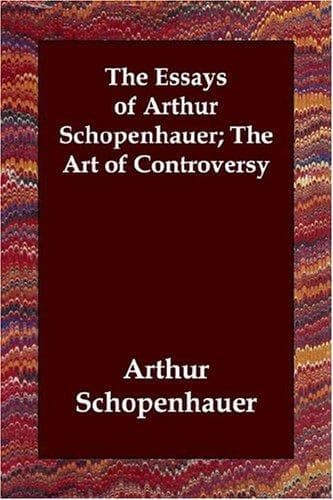
The Essays of Arthur Schopenhauer; the Art of ControversySchopenhauer, Arthur
Philosophy
The Essays of Arthur Schopenhauer; the Art of Controversy
Schopenhauer, Arthur
Debates and debating; Logic
This maxim of egoism, which has, indeed, its advantages in procuring
the means to the end in view, itself concurrently destroys the
ultimate end, namely, contentment; like the bear in the fable that
throws a stone at the hermit to kill the fly on his nose. We ought to
wait until need and privation announce themselves, instead of
looking for them. Minds that are naturally content do this, while
hypochondrists do the reverse.
* * * * *
A man's nature is in harmony with itself when he desires to be nothing
but what he is; that is to say, when he has attained by experience a
knowledge of his strength and of his weakness, and makes use of the
one and conceals the other, instead of playing with false coin, and
trying to show a strength which he does not possess. It is a harmony
which produces an agreeable and rational character; and for the simple
reason that everything which makes the man and gives him his mental
and physical qualities is nothing but the manifestation of his will;
is, in fact, what he _wills_. Therefore it is the greatest of all
inconsistencies to wish to be other than we are.
* * * * *
People of a strange and curious temperament can be happy only under
strange circumstances, such as suit their nature, in the same way as
ordinary circumstances suit the ordinary man; and such circumstances
can arise only if, in some extraordinary way, they happen to meet with
strange people of a character different indeed, but still exactly
suited to their own. That is why men of rare or strange qualities are
seldom happy.
* * * * *
All this pleasure is derived from the use and consciousness of power;
and the greatest of pains that a man can feel is to perceive that
his powers fail just when he wants to use them. Therefore it will be
advantageous for every man to discover what powers he possesses, and
what powers he lacks. Let him, then, develop the powers in which he is
pre-eminent, and make a strong use of them; let him pursue the path
where they will avail him; and even though he has to conquer his
inclinations, let him avoid the path where such powers are requisite
as he possesses only in a low degree. In this way he will often have a
pleasant consciousness of strength, and seldom a painful consciousness
of weakness; and it will go well with him. But if he lets himself be
drawn into efforts demanding a kind of strength quite different from
that in which he is pre-eminent, he will experience humiliation; and
this is perhaps the most painful feeling with which a man can be
afflicted.
Public-domain text, read in full here on John Shaqi.
Reviews
Reviews
No reviews yet
Be the first to share your thoughts on this work.
Elsewhere in the archive
Join the Discussion
Join the discussion
Sign in to leave a comment or review.
Sign InorCreate an account