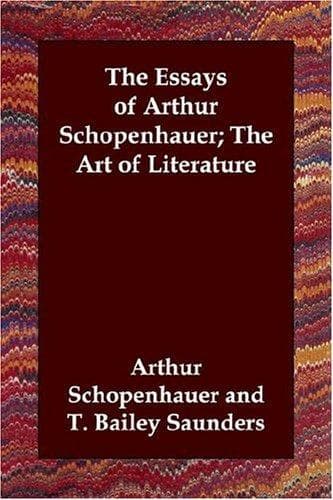
The Essays of Arthur Schopenhauer; The Art of LiteratureSchopenhauer, Arthur
Philosophy
The Essays of Arthur Schopenhauer; The Art of Literature
Schopenhauer, Arthur
Literature -- Philosophy
The climax is reached with the third stage, which is the most
difficult. There the drama aims at being _tragic_. We are brought face
to face with great suffering and the storm and stress of existence;
and the outcome of it is to show the vanity of all human effort.
Deeply moved, we are either directly prompted to disengage our will
from the struggle of life, or else a chord is struck in us which
echoes a similar feeling.
The beginning, it is said, is always difficult. In the drama it is
just the contrary; for these the difficulty always lies in the end.
This is proved by countless plays which promise very well for
the first act or two, and then become muddled, stick or
falter--notoriously so in the fourth act--and finally conclude in a
way that is either forced or unsatisfactory or else long foreseen by
every one. Sometimes, too, the end is positively revolting, as in
Lessing's _Emilia Galotti_, which sends the spectators home in a
temper.
This difficulty in regard to the end of a play arises partly because
it is everywhere easier to get things into a tangle than to get them
out again; partly also because at the beginning we give the author
_carte blanche_ to do as he likes, but, at the end, make certain
definite demands upon him. Thus we ask for a conclusion that shall be
either quite happy or else quite tragic; whereas human affairs do not
easily take so decided a turn; and then we expect that it shall be
natural, fit and proper, unlabored, and at the same time foreseen by
no one.
These remarks are also applicable to an epic and to a novel; but the
more compact nature of the drama makes the difficulty plainer by
increasing it.
_E nihilo nihil fit_. That nothing can come from nothing is a maxim
true in fine art as elsewhere. In composing an historical picture, a
good artist will use living men as a model, and take the groundwork
of the faces from life; and then proceed to idealize them in point of
beauty or expression. A similar method, I fancy, is adopted by good
novelists. In drawing a character they take a general outline of it
from some real person of their acquaintance, and then idealize and
complete it to suit their purpose.
A novel will be of a high and noble order, the more it represents
of inner, and the less it represents of outer, life; and the ratio
between the two will supply a means of judging any novel, of whatever
kind, from _Tristram Shandy_ down to the crudest and most sensational
tale of knight or robber. _Tristram Shandy_ has, indeed, as good as
no action at all; and there is not much in _La Nouvelle Heloïse_ and
_Wilhelm Meister_. Even _Don Quixote_ has relatively little; and what
there is, very unimportant, and introduced merely for the sake of fun.
And these four are the best of all existing novels.
Public-domain text, read in full here on John Shaqi.
Reviews
Reviews
No reviews yet
Be the first to share your thoughts on this work.
Join the Discussion
Join the discussion
Sign in to leave a comment or review.
Sign InorCreate an account