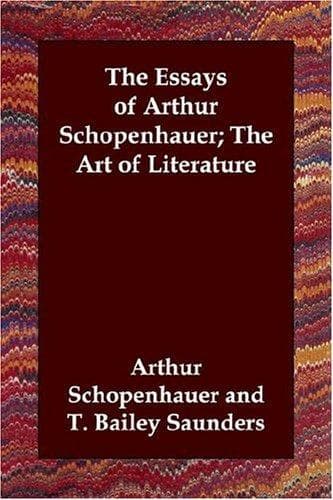
The Essays of Arthur Schopenhauer; The Art of LiteratureSchopenhauer, Arthur
Philosophy
The Essays of Arthur Schopenhauer; The Art of Literature
Schopenhauer, Arthur
Literature -- Philosophy
The perceptive critical taste is, so to speak, the female analogue
to the male quality of productive talent or genius. Not capable
of _begetting_ great work itself, it consists in a capacity of
_reception_, that is to say, of recognizing as such what is right,
fit, beautiful, or the reverse; in other words, of discriminating
the good from the bad, of discovering and appreciating the one and
condemning the other.
In appreciating a genius, criticism should not deal with the errors in
his productions or with the poorer of his works, and then proceed to
rate him low; it should attend only to the qualities in which he most
excels. For in the sphere of intellect, as in other spheres, weakness
and perversity cleave so firmly to human nature that even the most
brilliant mind is not wholly and at all times free from them. Hence
the great errors to be found even in the works of the greatest men; or
as Horace puts it, _quandoque bonus dormitat Homerus_.
That which distinguishes genius, and should be the standard for
judging it, is the height to which it is able to soar when it is in
the proper mood and finds a fitting occasion--a height always out
of the reach of ordinary talent. And, in like manner, it is a very
dangerous thing to compare two great men of the same class; for
instance, two great poets, or musicians, or philosophers, or artists;
because injustice to the one or the other, at least for the moment,
can hardly be avoided. For in making a comparison of the kind the
critic looks to some particular merit of the one and at once discovers
that it is absent in the other, who is thereby disparaged. And then
if the process is reversed, and the critic begins with the latter and
discovers his peculiar merit, which is quite of a different order from
that presented by the former, with whom it may be looked for in vain,
the result is that both of them suffer undue depreciation.
There are critics who severally think that it rests with each one of
them what shall be accounted good, and what bad. They all mistake
their own toy-trumpets for the trombones of fame.
A drug does not effect its purpose if the dose is too large; and it
is the same with censure and adverse criticism when it exceeds the
measure of justice.
Public-domain text, read in full here on John Shaqi.
Reviews
Reviews
No reviews yet
Be the first to share your thoughts on this work.
Join the Discussion
Join the discussion
Sign in to leave a comment or review.
Sign InorCreate an account