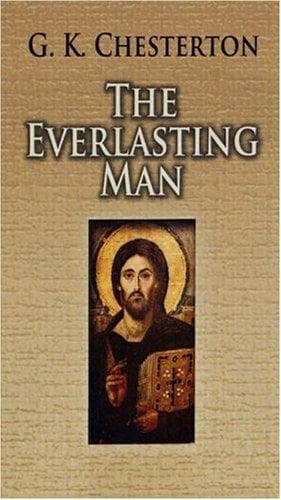
The Everlasting ManChesterton, G. K. (Gilbert Keith)
Religion
The Everlasting Man
Chesterton, G. K. (Gilbert Keith)
Catholic Church -- Apologetic works; Christianity and other religions; Religion
It is admitted that we owe most of this science to the priests. Modern
writers like Mr. Wells cannot be accused of any weakness of sympathy
with a pontifical hierarchy; but they agree at least in recognising what
pagan priesthoods did for the arts and sciences. Among the more ignorant
of the enlightened there was indeed a convention of saying that priests
had obstructed progress in all ages; and a politician once told me in a
debate that I was resisting modern reforms exactly as some ancient
priest probably resisted the discovery of wheels. I pointed out, in
reply, that it was far more likely that the ancient priest made the
discovery of the wheels. It is overwhelmingly probable that the ancient
priest had a great deal to do with the discovery of the art of writing.
It is obvious enough in the fact that the very word hieroglyphic is akin
to the word hierarchy. The religion of these priests was apparently a
more or less tangled polytheism of a type that is more particularly
described elsewhere. It passed through a period when it co-operated with
the king, another period when it was temporarily destroyed by the king,
who happened to be a prince with a private theism of his own, and a
third period when it practically destroyed the king and ruled in his
stead. But the world has to thank it for many things which it considers
common and necessary; and the creators of those common things ought
really to have a place among the heroes of humanity. If we were at rest
in a real paganism, instead of being restless in a rather irrational
reaction from Christianity, we might pay some sort of pagan honour to
these nameless makers of mankind. We might have veiled statues of the
man who first found fire or the man who first made a boat or the man who
first tamed a horse. And if we brought them garlands or sacrifices,
there would be more sense in it than in disfiguring our cities with
cockney statues of stale politicians and philanthropists. But one of
the strange marks of the strength of Christianity is that, since it
came, no pagan in our civilisation has been able to be really human.
Public-domain text, read in full here on John Shaqi.
Reviews
Reviews
No reviews yet
Be the first to share your thoughts on this work.
Join the Discussion
Join the discussion
Sign in to leave a comment or review.
Sign InorCreate an account