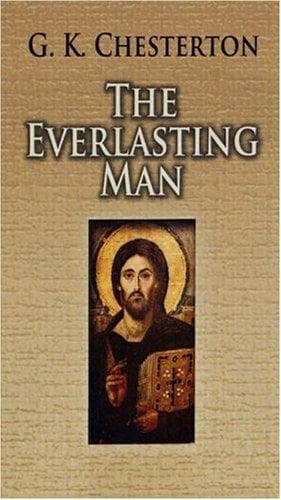
The Everlasting ManChesterton, G. K. (Gilbert Keith)
Religion
The Everlasting Man
Chesterton, G. K. (Gilbert Keith)
Catholic Church -- Apologetic works; Christianity and other religions; Religion
There are some who will learn with regret that it seems to have begun
with a pun. The king or the priests or some responsible persons, wishing
to send a message up the river in that inconveniently long and narrow
territory, hit on the idea of sending it in picture-writing, like that
of the Red Indian. Like most people who have written picture-writing for
fun, he found the words did not always fit. But when the word for taxes
sounded rather like the word for pig, he boldly put down a pig as a bad
pun and chanced it. So a modern hieroglyphist might represent ‘at once’
by unscrupulously drawing a hat followed by a series of upright
numerals. It was good enough for the Pharaohs and ought to be good
enough for him. But it must have been great fun to write or even to read
these messages, when writing and reading were really a new thing. And if
people must write romances about ancient Egypt (and it seems that
neither prayers nor tears nor curses can withhold them from the habit),
I suggest that scenes like this would really remind us that the ancient
Egyptians were human beings. I suggest that somebody should describe the
scene of the great monarch sitting among his priests, and all of them
roaring with laughter and bubbling over with suggestions as the royal
puns grew more and more wild and indefensible. There might be another
scene of almost equal excitement about the decoding of this cipher; the
guesses and clues and discoveries having all the popular thrill of a
detective story. That is how primitive romance and primitive history
really ought to be written. For whatever was the quality of the
religious or moral life of remote times, and it was probably much more
human than is conventionally supposed, the scientific interest of such a
time must have been intense. Words must have been more wonderful than
wireless telegraphy; and experiments with common things a series of
electric shocks. We are still waiting for somebody to write a lively
story of primitive life. The point is in some sense a parenthesis here;
but it is connected with the general matter of political development, by
the institution which is most active in these first and most fascinating
of all the fairy-tales of science.
Public-domain text, read in full here on John Shaqi.
Reviews
Reviews
No reviews yet
Be the first to share your thoughts on this work.
Join the Discussion
Join the discussion
Sign in to leave a comment or review.
Sign InorCreate an account