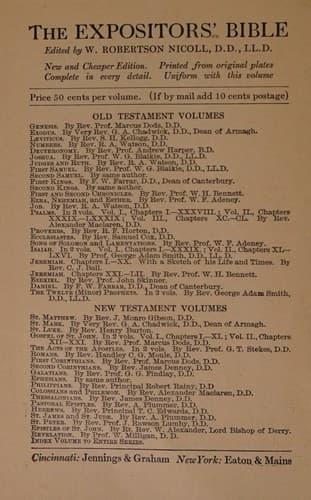
The Expositor's Bible: The Book of RevelationMilligan, William
Philosophy
The Expositor's Bible: The Book of Revelation
Milligan, William
Bible. Revelation -- Commentaries
Yet there also the Good Shepherd had His little flock, and there again
we meet them. _But thou hast a few names in Sardis which did not
defile their garments._ These were to Sardis what "the rest" were to
Thyatira. They were the "gleanings left in Israel, as the shaking of
an olive tree, two or three berries in the top of the uppermost bough,
four or five in the outmost branches of a fruitful tree."[82] They
were the "new wine found in the cluster, and one saith, Destroy it
not; for a blessing is in it."[83] To them therefore great promises
are given: _They shall walk with Me in white; for they are worthy. He
that overcometh shall thus be arrayed in white garments; and I will in
no wise blot his name out of the book of life, and I will confess his
name before My Father, and before His angels._ It is the glorified
Lord who, as the High-priest of His Church, "walketh" in the midst of
the golden candlesticks; and, as priests, these shall _walk with_ Him
in a similar glory. Upon earth they were despised, but beyond the
earth they shall be openly acknowledged and vindicated. They shall be
arrayed in those garments of glistering purity which were with
difficulty kept white in the world, but which in the world to come
Divine favour shall keep free from every stain.
6. The sixth epistle is to Philadelphia; and the remarkable circumstance
connected with this church is that, though spoken of as having but "a
little power," it is not seriously blamed. In this respect it resembles
the church at Smyrna in the first group of these seven epistles. What
has mainly to be noticed, however, is that it is not simply, like that
at Smyrna, a suffering church. It has been engaged in an earnest and hot
struggle with the world, as the superscription, the commendation, and
the promises of the epistle combine to testify.
The superscription is, _These things saith He that is holy, He that is
true, He that hath the key of David, He that openeth, and none shall
shut, and that shutteth, and none openeth_. The figure is taken from
the Old Testament; and both there and here the context shows us that
it is neither the key of knowledge, nor the key of discipline, nor the
key of the treasures of the kingdom that is spoken of, but the key of
power to open the Lord's house as a sure refuge from all evil, and to
preserve safe for ever those who are admitted to it. "I will call My
servant Eliakim the son of Hilkiah," says the Almighty by His prophet,
"and I will clothe him with thy robe, and strengthen him with thy
girdle, and I will commit thy government into his hand: and he shall
be a father to the inhabitants of Jerusalem, and to the house of
Judah. And the key of the house of David will I lay upon his shoulder;
and he shall open, and none shall shut; and he shall shut, and none
shall open."[84] Whoever be our adversaries, we know that in the
hollow of the Lord's hand we are safe.
Public-domain text, read in full here on John Shaqi.
Reviews
Reviews
No reviews yet
Be the first to share your thoughts on this work.
Join the Discussion
Join the discussion
Sign in to leave a comment or review.
Sign InorCreate an account