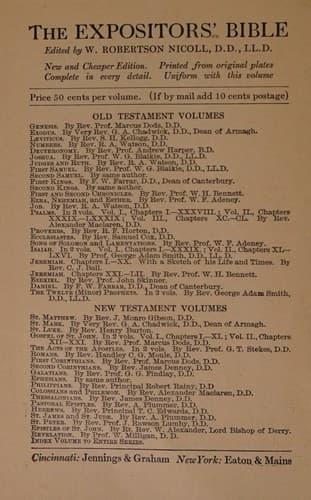
The Expositor's Bible: The Book of RevelationMilligan, William
Philosophy
The Expositor's Bible: The Book of Revelation
Milligan, William
Bible. Revelation -- Commentaries
One brief concluding remark ought to be made. The epistles now
considered ought to be sufficient in themselves to show that the
Apocalypse is not a series of visions intended only to illustrate one
or two ideas which had taken a strong hold of the Apostle's mind, or
one or two great principles of the Divine government in general. St.
John starts from the realities around him as much as any writer of the
New Testament. It is true that he sees in them _eternal_ principles at
work, and that he rises to the thought of ideal good and of ideal
evil; but he is not on that account less true to fact, less impressed
by fact. On the contrary, his very depth of insight into the meaning
of the facts makes him what he is. He who would write a philosophy of
history is not less, but more, dependent upon the facts of history
than he to whom a fact is valuable simply in its individual and
isolated form. It is _the present_ therefore that stirs the writer of
this book, but stirs him the more because he beholds in it principles
and issues connected with Him who was, and is, and is to come, the
covenant-keeping God, the Judge of _men_, the unchangeable I AM.
Hence also the mistake sometimes made of thinking that the purpose of
unfolding the principles of the Divine government could not be a
sufficient motive to St. John to write.[85] Every cruelty to the
saints of God which he witnessed, every cry of oppression which he
heard, supplied a motive. We may not feel these things now, but the
iron of them entered into the soul of the disciple whom Jesus loved.
We need more prophets like him to make it ring in the ears of selfish
wealth and of ease indifferent to the ills festering around it, "For
the spoiling of the poor, for the sighing of the needy, now will I
arise, saith the Lord."[86]
FOOTNOTES:
[24] Chaps. vii. 2; viii. 2; xiv. 6, 8, 9; xv. 1, 6.
[25] Chap. xiv. 15.
[26] Chaps. i. 1; xx. 1; xxii. 6.
[27] Chap. xvi. 5.
[28] Chap. xiv. 18.
[29] Chap. vii. 1.
[30] Chap. ix. 11.
[31] Chap. i. 4.
[32] Chap. ii. 1.
[33] Chap. ii. 8.
[34] Chap. ii. 12.
[35] Chap. ii. 18.
[36] Chap. iii. 1.
[37] Chap. iii. 7.
[38] Chap. iii. 14.
[39] Chaps. ii. 7; xxii. 2, 14.
[40] Chaps. ii. 11; xx. 14.
[41] Chaps. ii. 17; xiv. 1.
[42] Chaps. ii. 26, 28; xx. 4, 5; xxii. 16.
[43] Chaps. iii. 5; vii. 9, 14.
[44] Chaps. iii. 12; xxi. 2, 10.
[45] Chaps. iii. 21; xx. 4. Comp. Trench, _The Seven Epistles_, p. 37.
[46] Chap. ii. 1.
[47] Chap. iii. 14.
[48] Comp. Rom. viii. 21, 22; James i. 18.
[49] Chap. i. 19.
[50] Chap. ii. 7, 11, 17.
[51] Chaps. ii. 29; iii. 6, 13, 22.
[52] Chap. ii. 4.
[53] John xv. 2.
[54] Chap. ii. 14, 15.
[55] Comp. Heb. ii. 10.
[56] Chap. iii. 8.
[57] Chap. iii. 11.
[58] Chap. iii. 17.
[59] Chap. ii. 7.
[60] Chap. ii. 11.
[61] Chap. ii. 17.
[62] Chap. ii. 26, 27.
[63] Chap. iii. 5.
[64] Chap. iii. 12.
[65] Chap. iii. 21.
[66] Chap. xviii. 4.
[67] Matt. xxviii. 20.
[68] Ps. xxxi. 20.
[69] John xv. 20.
[70] Chap. i. 17.
Public-domain text, read in full here on John Shaqi.
Reviews
Reviews
No reviews yet
Be the first to share your thoughts on this work.
Join the Discussion
Join the discussion
Sign in to leave a comment or review.
Sign InorCreate an account