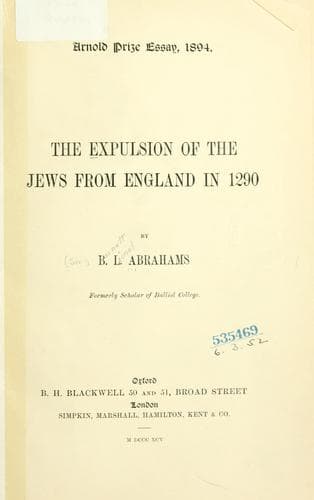
The expulsion of the Jews from England in 1290Abrahams, Barnett Lionel
History
The expulsion of the Jews from England in 1290
Abrahams, Barnett Lionel
Jews -- Great Britain -- History
The Expulsion of the English Jews was an event of small importance
alike in English and in Jewish history. In England the effect that
it produced was barely perceptible. The loss of their capital was
too slight to produce any economic change.[286] The only class that
benefited from their departure was the Florentine merchants, whose
trade grew from this time even greater than before.[287] Political
results of importance have sometimes been attributed to the Expulsion.
The victory of the towns over the King has been said to have been
hastened by the loss of the financial support of the Jews.[288]
But it cannot have come any the sooner for the disappearance of a
community from whom the King had long ceased to get any real help
in his enterprises abroad, or in his struggles at home. The trading
classes still complained after the Expulsion, as they had done before
it, of the prevalence of the “horrible practice of usury, which has
undone many, and brought many to poverty,”[289] and the “horrible
practice” prevailed none the less; and perhaps the poorer agricultural
classes of England, the newly enfeoffed rent-payers, found, as did the
corresponding class in France,[290] that the expulsion of the Jews
only compelled them to go to more cruel money-lenders than before.
The coin was clipped as regularly after the Expulsion as before it,
and the Christian goldsmiths were as rigorously treated as the Jewish
money-lenders had been.[291] The Church, which had helped to drive out
the Jews, soon found itself in conflict with Christian heresy, compared
with which Jewish unbelief was harmless.
The Jews, on their side, were driven from a land which thirty-five
years earlier they had begged in vain to be allowed to leave.[292]
They went forth to join the far greater bodies of their countrymen in
other lands, and with them to fulfil the career of sorrow that they
had begun. The loss of their inhospitable home in England was but one
episode in their tragic history. From France they were again to be
expelled, despoiled and destitute.[293] In Germany the blood-accusation
met them as in England.[294] In Spain popular massacres and clerical
persecution were already preparing the ground for the Inquisition.[295]
The time was still far off when Jew and Christian could live side
by side and neither suffer because he would not worship after his
neighbour’s fashion. That time could not come until society was more
heterogeneous, and the circles of interest of ordinary men wider, than
they could be in the thirteenth century, until the citizen ceased to
live his life, bodily and spiritual, within the walls of his native
town, under the shadow of the Church.
FOOTNOTES:
[1] J. Jacobs, _Jews of Angevin England_, 43–4; 64–5.
[2] Cf. the account of the litigation of Richard of Anesty in
Palgrave’s _Rise and Progress of the English Commonwealth_, Vol. II.
(Proofs and Illustrations), pp. xxiv.–xxvii.
Public-domain text, read in full here on John Shaqi.
Reviews
Reviews
No reviews yet
Be the first to share your thoughts on this work.
Elsewhere in the archive
Join the Discussion
Join the discussion
Sign in to leave a comment or review.
Sign InorCreate an account