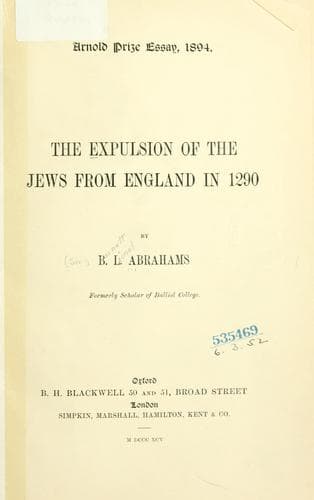
The expulsion of the Jews from England in 1290Abrahams, Barnett Lionel
History
The expulsion of the Jews from England in 1290
Abrahams, Barnett Lionel
Jews -- Great Britain -- History
[140] _Liber Custumarum_ (Rolls Series), xxxiv.–xlviii., 61–72; _Liber
Albus_, xcv., xcvi., 287; Macpherson, _Annals of Commerce_, I. 388–9.
[141] _Liber Custumarum_ and _Liber Albus_, as referred to in preceding
note: Cunningham, _Growth of English Industry and Commerce, Early
and Middle Ages_, 181–6; Ochenkowski, _Englands wirthschaftliche
Entwickelung_, 180; _Calendar of State Papers (Venetian)_, lx.–lxix.;
Peruzzi, _Storia dei Banchieri e del Commercio di Firenze_, 70.
[142] Cunningham, _Growth_, etc., 185; Macpherson, _Annals of
Commerce_, pp. 415, 481; _Calendar of State Papers (Venetian)_,
lxvi.–lxvii.
[143] Jacobs, 66–7; _Archæological Journal_, xxxviii. 179.
[144] This was the procedure adopted by the Italians: They paid down a
sum as earnest-money, and then took a bond (Peruzzi, 70). Cf. Tovey,
207.
[145] For pledges still unredeemed, land still in the hands of the Jews
and old debts still unpaid long after the Statutes of 1270–1275 had
been passed, see MSS. in Public Record Office (_Queen’s Remembrancer’s
Miscellanea_, 557, 13–23); Rymer, I. 570; John of Peckham, I. 937;
_Calendar of Patent Rolls_, 1281–1292, p. 81; Prynne, _Second
Demurrer_, pp. 74 and 80 (=154).
[146] Labbeus, _Sacrosancta Concilia_, XI. 649–50.
[147] Vinogradoff, _Villeinage in England_, 179, 307.
[148] M. Paris, V. 245; Wilkins, _Conc._, I. 675; _De Antiq. Legibus_,
234 sq. (Archbishop of York’s remarks on the corruption of the Great
Council and on the _fautores_ of Jews.)
[149] M. Paris, _Chronica Majora_, V. 404–5.
[150] Muratori, _Antiquitates Italicæ Medii Aevi_, I., 893.
[151] _Rotuli Parliamentorum_, I. 1, 2.
[152] “The Debts and Houses of the Jews of Hereford,” in _Transactions
of the Jewish Historical Society of England_, vol. I.
[153] _Royal Letters_ (Rolls Series), II. 24.
[154] _Leet Jurisdiction of Norwich_ (Selden Society), p. 10; Cf.
_Ancren Riwle_ (Camden Society), 395. “Do not men account him a good
friend who layeth his pledge in _Jewry_ to redeem his companion?”
[155] Rymer, _Foedera_, I. 503, 634; _Papers of the Anglo-Jewish
Historical Exhibition_, 187–190.
[156] _Norfolk Antiquarian Miscellany_, I. 326, quoted _supra_, p. 20
(_n._ 3).
[157] _Calendar of Patent Rolls_, 1281–1292, p. 98; _Papers
Anglo-Jewish Hist. Ex._ 167.
[158] See _Dictionary of Political Economy_, Article JEWS, (House for
Converted).
[159] _Chronica Majora_, V. 15.
[160] _Annales Monastici_ (Rolls Series), II. 339.
[161] M. Paris, _Chronica Majora_, V. 15, 16.
[162] Ruding, _Annals of the Coinage_, I. 179.
[163] Ashley, _Economic Hist., Theory_, I. 169.
[164] Ashley, I., 215, n. 95; cf. Jacobs, 73 and 225.
[165] _Annales Monastici_ (Rolls Series), IV. 278.
[166] _Annales Monastici_, IV. 278; _Liber Custumarum_, 189.
[167] John of Peckham, _Registrum Epistolarum_ (Rolls Series), I. 22.
[168] _Annales Monastici_, III. 295.
[169] _Historia Anglorum_, III. 76.
[170] Tovey, 109; Madox, _History of the Exchequer_ I. 245, z.
Public-domain text, read in full here on John Shaqi.
Reviews
Reviews
No reviews yet
Be the first to share your thoughts on this work.
Elsewhere in the archive
Join the Discussion
Join the discussion
Sign in to leave a comment or review.
Sign InorCreate an account