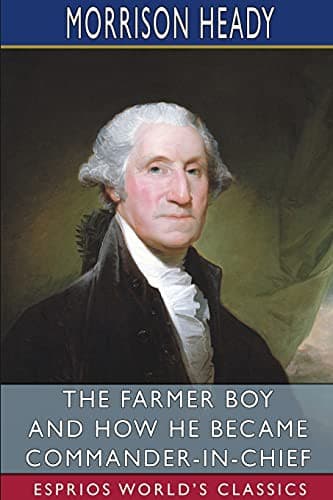
The Farmer Boy, and How He Became Commander-In-ChiefHeady, Morrison
History
The Farmer Boy, and How He Became Commander-In-Chief
Heady, Morrison
Washington, George, 1732-1799
All things being at last in readiness, the gallant little party,
headed by our young Virginian, turned their faces towards the great
North-west; and, plunging into the wilderness, were soon beyond all
traces of civilized man. The autumn was far advanced. The travelling
was rendered toilsome, and even dangerous, by the heavy rains of this
season, and early snows that had already fallen on the mountains,
which had changed the little rills into rushing torrents, and the low
bottom-lands into deep and miry swamps. Much delayed by these and the
like hinderances, Washington, upon reaching the banks of the
Monongahela, deemed it best to send two of the backwoodsmen with the
baggage in canoes down this river to its mouth, where, uniting its
waters with those of the Allegheny, it helped to form the great Ohio.
Promising to meet them at this point, he and the rest of the party
pushed thitherward by land on horseback. Reaching the Forks of the
Ohio two days before the canoe-men, he spent the time in exploring the
woods and hills and streams around, and was much struck with the
advantages the place held out as a site for a military post. This,
together with other items meriting attention that happened to him or
occurred to his mind during the expedition, he carefully noted down in
a journal which he kept, to be laid, in the form of a report, before
Gov. Dinwiddie, upon his return. The following year, as a convincing
proof to his countrymen how entirely they might rely on his foresight
and judgment in such matters, French officers of skill and experience
chose this very spot to be the site of Fort Duquesne, afterwards so
famous in the border history of our country. Near the close of the
war, this post fell into the hands of the English, who changed its
name to that of Fort Pitt; which in time gave rise to the busy,
thriving, noisy, dingy, fine young town of Pittsburg, a smoky-looking
picture of which you may see any time you choose to consult your
geography.
Instead of pushing on directly to the Lakes, Major Washington turned a
little aside from his course, and went down the Ohio about twenty
miles, to an Indian village called Logstown. Here, as had been
previously arranged, he met a few sachems or chiefs of some of the
Western tribes, to kindle a council-fire and have a Big Talk. He was
received with much hospitality and courtesy by a stately old chief,
whose Indian name you would not care to hear, as it would give Master
Charlie's nut-crackers the jaw-ache to pronounce it. Among the
English, however, as he was the head of a league or union of several
tribes, he usually went by the name of the Half King. After the pipe
had passed with all due gravity from mouth to mouth, and every
warrior, chief, and white man present had taken a whiff or two, in
sign that all was good-will and peace between them, Washington arose,
and addressed the Half King in a short speech, somewhat after the
following manner:--
Public-domain text, read in full here on John Shaqi.
Reviews
Reviews
No reviews yet
Be the first to share your thoughts on this work.
Elsewhere in the archive
Join the Discussion
Join the discussion
Sign in to leave a comment or review.
Sign InorCreate an account