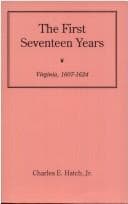
The First Seventeen Years: Virginia 1607-1624Hatch, Charles E., Jr.
History
The First Seventeen Years: Virginia 1607-1624
Hatch, Charles E., Jr.
Virginia -- History -- Colonial period, ca. 1600-1775
The plantations were represented as a group in the Assembly of 1624 by
Samuel Mathews and Edward Grindon. Collectively, in 1624, they had a
reported population of thirty-three. In that year twenty-one persons
died, two having been slain by the Indians. It is not until the census
of 1625 that a number of the plantations in this section are clearly
identified. Five such are listed with a total population of ninety-six
persons. This was clearly a growing community at this time.
In May, 1625, it is of record that in excess of 3,700 acres had been
taken up in "The territory of Tappahanna over against James Citie" by
sixteen persons. Eleven of the grants were noted as "planted." The
largest single grant was to William Ewens for 1,000 acres. It should be
noted, perhaps, that no acreage figure was shown for the "Divident" of
Captain Samuel Mathews and that of Captain John Hurleston. Among those
listed as having received grants, and some were dead, were John Rolfe
(400 acres), Richard Pace (200 acres), Captain William Powell (750 acres
in two parcels), George Sandys (300 acres), and John Burrows (150
acres). All were "planted." Only the acreage of John Dodd, Francis
Chapman, Thomas Gates, John Utie and Robert Evers were not "planted."
THE TREASURER'S PLANTATION (GEORGE SANDYS) (33A)
George Sandys was named resident treasurer of the Colony and came to
Virginia in the ship _George_ in 1621. He, it seems, soon became
interested in the area over the water from Jamestown. His patent for 300
acres, here, as Treasurer of Virginia, is dated in December, 1624, yet
he was already "actually possessed" of this dividend, 100 acres of which
was for a bill of adventure for a share of Company stock and 200 for the
transportation of four persons to Virginia in 1621. He had William
Claiborne survey "at his plantation over the water" 650 acres including
his and parcels belonging to John Bainham and Edward Grindon. This was
"by the water side" and was about a square mile in extent as reported by
Claiborne. Evidently Sandys was actually in possession of all three
tracts at the time of the survey.
In 1625 his plantation had seventeen servants including two boys, and
Daniel Poole, "a french man" with his wife and "a yong child of
theires." Poole was defined as a "hired" man. Besides his own people,
another twenty-two lived "in the Treasurors Plant." In this number were
two women and several Italians. His was, perhaps, one of the best
equipped plantations in Virginia. There were two dwellings, cabins, two
stores, a framed house for raising silkworms, a vineyard of two acres,
and an acre and a half garden as well as "one large fort palled in" and
a piece of mounted ordnance. His 100 barrels of corn was the largest
amount reported by any single plantation. His arms were
extensive--thirty "armours" of various types, thirty small arms and
twenty swords. He was, however, a little short on livestock having only
nine goats and kids and two hogs.
Public-domain text, read in full here on John Shaqi.
Reviews
Reviews
No reviews yet
Be the first to share your thoughts on this work.
Elsewhere in the archive
Join the Discussion
Join the discussion
Sign in to leave a comment or review.
Sign InorCreate an account