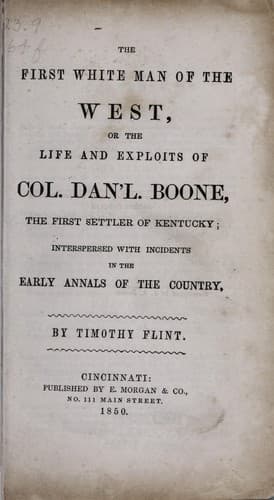
The First White Man of the West: Life and Exploits of Col. Dan'l. Boone, the First Settler of Kentucky;; Interspersed with Incidents in the Early Annals of the Country.Flint, Timothy
History
The First White Man of the West: Life and Exploits of Col. Dan'l. Boone, the First Settler of Kentucky;; Interspersed with Incidents in the Early Annals of the Country.
The fort being finished, Boone returned to his family, and soon after
removed them to this first garrison of Kentucky. The purpose on which
his heart had so long been set, was now accomplished. His wife and
daughters were the first white women that ever stood on the banks of
Kentucky river. In our zeal to blazon our subject, it is not affirmed,
that Boone was absolutely the first discoverer and explorer of Kentucky,
for he was not. But the high meed of being the first actual settler and
cultivator of the soil, cannot be denied him. It was the pleasant season
of the close of summer and commencement of autumn, when the immigrants
would see their new residence in the best light. Many of its actual
inconveniences were withheld from observation, as the mildness of the
air precluded the necessity of tight dwellings. Arrangements were made
for cultivating a field in the coming spring. The Indians, although far
from friendly, did not attempt any immediate assault upon their new
neighbors, and the first events of the settlement were decidedly
fortunate. The game in the woods was an unfailing resource for food. The
supplies brought from their former homes by the immigrants were not yet
exhausted, and things went on in their usual train, with the added
advantage, that over all, in their new home, was spread the charm of
novelty.
Winter came and passed with as little discomfort to the inmates of the
garrison as could be expected from the circumstances of their position.
The cabins were thoroughly daubed, and fuel was of course abundant. It
is true, those who felled the trees were compelled to be constantly on
their guard, lest a red man should take aim at them from the shelter of
some one of the forest hiding places. But they were fitted for this way
of getting along by their training, natures, and predilections. There
was no want of excitement during the day, or even night--nothing of the
wearying monotony to which a life of safe and regular occupation is
subject. Spring opened. The trees were girdled, and the brush cut down
and burned, preparatory to ploughing the field. A garden spot was marked
off, the virgin earth thrown up and softened, and then given in charge
to the wives and daughters of the establishment. They brought out their
stock of seeds, gathered in the old settlements, and every bright day
saw them engaged in the light and healthful occupation of planting them.
They were protected by the vicinity of their husbands and fathers, and
in turn cheered them in their severer labors. The Indians had forborne
any attacks upon the settlers so long, that, as is naturally the case,
they had ceased in a degree to dwell upon the danger always to be
apprehended from them. The men did not fail to take their rifles and
knives with them whenever they went abroad; but the women ventured
occasionally a short distance without the palisades during the day,
never, however, losing sight of the fort. This temerity was destined to
cost them dear.
Public-domain text, read in full here on John Shaqi.
Reviews
Reviews
No reviews yet
Be the first to share your thoughts on this work.
Join the Discussion
Join the discussion
Sign in to leave a comment or review.
Sign InorCreate an account