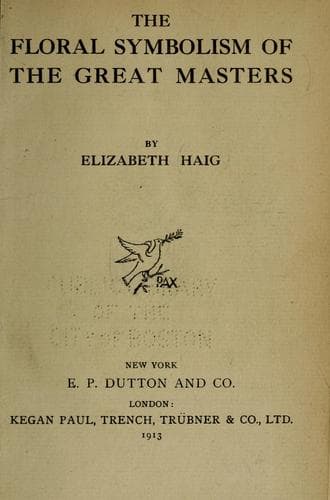
The floral symbolism of the great mastersHaig, Elizabeth
Religion
The floral symbolism of the great masters
Haig, Elizabeth
Flowers -- Symbolic aspects
Thus in the fourth century there were representations of martyrdoms,
and in the fifth century single figures of the martyrs more or less
idealized, but they apparently carried the crown of victory, ‘the
crown of their high calling,’ not the palm. But though the crown was
generally used, the palm of the primitive Christian Church was not
forgotten, for, as Cassiodorus, writing at the beginning of the sixth
century, points out, it was palms which, in the eyes of the people,
indicated those strong athletes who were victorious, and advocates
their use as a religious symbol.
Palms at this period seem to have been used as an emblem of the public
games themselves. On the consular diptyches, the double tablets of
ivory which a consul had carved to commemorate his entry into office,
it was customary to put palms beneath the figure of the consul, among
the bags of money and other objects that were supposed to represent the
benefits which would accrue to the populace beneath his rule.
It was probably this secular use of the palm which excluded it from
the symbolism of the Church during the early centuries, for it is palm
trees not palm branches which are found in the early mosaics, notably
those of S. Apollinare Nuova in Ravenna, where palm trees alternate
with the figures round the frieze, and palm trees, according to St
Ambrose, were not the symbol of victory but the emblem of the righteous
man, ‘for its roots are upon the earth but its head is lifted towards
the heavens.’
But by the thirteenth century the public games had dropped from Italian
social life, and religious art reverted once more to the palm branch
of the catacombs as the symbol of a martyr’s triumph over death.
Durandus, writing about the year 1286, unites the different renderings
of the palm’s significance. He says: ‘Martyrs are painted with the
instruments of their torture and sometimes with palms, which signify
victory, according to that saying:
‘“The righteous shall flourish like a palm tree; as a palm tree
flourishes, so his memory shall be preserved.”’[154]
After the Renaissance martyrs were very generally depicted with palms,
either in place of, or in addition to, the instruments of their
martyrdom. They varied in size and shape, from the tiny closed palm
no longer than a human hand, used by Cimabue,[155] to the magnificent
pedestal of palm branches on which Carpaccio has set his ‘Saint Ursula
in Glory.’[156] Saint Christopher, the giant saint, in consideration
of his size, was always allowed a whole palm tree as his staff, but a
whole palm tree, or the tiniest scrap of its foliage, carried exactly
the same meaning.
The palm is also given occasionally to several saints who have not
suffered a violent death, but have been conspicuous for their victory
over pain and temptation; for instance, Saint Francis, Saint Catharine
of Siena and Saint Clare.
Public-domain text, read in full here on John Shaqi.
Reviews
Reviews
No reviews yet
Be the first to share your thoughts on this work.
Join the Discussion
Join the discussion
Sign in to leave a comment or review.
Sign InorCreate an account