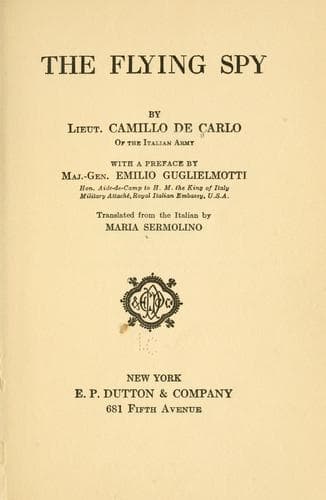
World War, 1914-1918 -- Personal narratives, Italian
“_Oh rare, delightful sweetheart_” ... the familiar melody is recalled
by the buzzing of the motor and repeats itself continually in my ears.
At times while listening to the powerful voice of the “Isotta” I feel
as if there were many instruments playing in the night and the
alternating melodies and varying modulations in the orchestration
recall the classic symphonies in which the greatest artists of sound
have expressed with majestic power the rhythmic significance of their
thought and the fury of their passions.
The Castle of Saint Salvador appears on top of the hills and although
our guns must have fired at it frequently it still preserves its
original structure and the heavy tower, which has something German
about it, still rests on the high sloping roof. This castle belongs to
an Austrian and, perhaps because his countrymen have spared it,
undeviating justice has loosed against it the fury of our guns. The
reverse of the hills which point towards Conegliano slopes slowly
towards the hills of Pieve di Soligo, while the broad road of Susegana
and Conegliano glimmers distinctly beneath us.
Gelmetti has inserted the handle of the silencer, and as though by
magic the concert of the marvelous instruments which had echoed many
distant songs in my mind ceases. We now feel as if we were sliding
through air, the same impression one feels while coasting in an
automobile whose engine has been shut off.
The enemy territory is less illuminated than ours. The lights in the
villages are scarce, and there are few searchlights turned towards us.
As though by magic the enemy anti-aircraft batteries become silent. The
reason for their silence is obvious; the Austrians have many of their
own bombing planes in the sky and they certainly have not noticed the
slight humming of our motor. Along the road of Susegana to Conegliano
Pordenone, great green lights are lit from which many colored rays
shoot forth at intervals. It is the first time I have observed those
lights in enemy territory but I have heard about them from Lieutenant
Ancilotto who often goes on nocturnal flights to try to down some enemy
bombing plane which finds in the obscurity of the night the courage to
attempt what it dares not in the daytime. These signals are placed at
convenient intervals so that if some enemy plane loses its way in the
fog and cannot find its bearings, all it need do is to fly low over the
lights which often indicate a safe place for a landing.
Public-domain text, read in full here on John Shaqi.
Reviews
Reviews
No reviews yet
Be the first to share your thoughts on this work.
Elsewhere in the archive
Join the Discussion
Join the discussion
Sign in to leave a comment or review.
Sign InorCreate an account