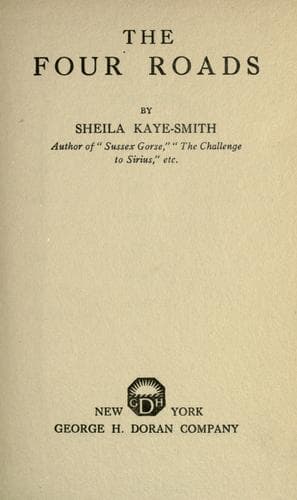
Sussex (England) -- Fiction; World War, 1914-1918 -- England -- Fiction
“Well,” said old Juglery, “I’ve bin on farm-work man and boy these
dunnamany year, and I’ve only bruk up grass two times, and no good
come of it, nuther. Wunst it wur fur oald Mus’ Backfield up at Odiam,
him wot caum to nighe a hundred year, and then took a fit last
fall and died of joy when he heard as wheat wur ninety shillings a
quarter. T’other wur pore young Mus’ Pix of the Trulilows, and he
bruk up a valiant pasture, and the oats caum up crawling about like
pease, and each had a gurt squlgy root lik a pertater. I says to him,
being young and joking like in those days, ‘You’re unaccountable
lucky,’ says I, ‘to grow pease and pertaters on the same stalk,’ but
he took it to heart, and went and shot himself in the oast. So you
see as boath the yeomen I bruk up grass fur died, one o’ joy and
t’other o’ sorrow.”
“Well, I shan’t die of nuther, and we’ll have the plough out Thursday
if the weather hoalds.”
The men were getting used to being ordered about by Harry. Mus’
Beatup’s chill had gone off in a twisting bout of rheumatism, which
returned every now and then with damp weather. He spent, therefore,
a good deal of time in the house, with sometimes a hobble as far
as the Rifle Volunteer, appearing only in the dry, frosty weather
when little could be done with harrow or plough. However, when
neighbouring farmers began to remark on the enterprise of Worge, he
was careful to take the credit to himself—indeed he almost fancied
that it was his own doing, for Harry, who could have done nothing
without his authority, was careful to consult him on every occasion,
and it was Mus’ Beatup who ordered the grain and checked the
accounts, with many groans and dismal foretellings.
Those were good days for Harry, behind his plough. Under the soft
grey spring sky, rifted and stroked by wandering primrose lights,
through the damp air that smelled of living mould, over the brown
earth that rolled and sprayed like a wave from the driving coulter,
he toiled sweating in the raw March cold. The smell of earth, the
smell of his own sweat, the smell of the sweat of his horses hung
thick over the plough, but every now and then soft damp puffs of air
would blow into the miasma the fragrance of grass and primrose buds,
of sticky, red, uncurling leaves, and the new moss in the woods. The
share gleamed against the dun, and the brown twigs of the copses drew
their spindled tracery against a sky which was the paler colour of
earth—sometimes a shower would fall, slanting along the hedges, the
thick drops tasting on Harry’s lips of the unfulfilled spring.
Public-domain text, read in full here on John Shaqi.
Reviews
Reviews
No reviews yet
Be the first to share your thoughts on this work.
Elsewhere in the archive
Join the Discussion
Join the discussion
Sign in to leave a comment or review.
Sign InorCreate an account