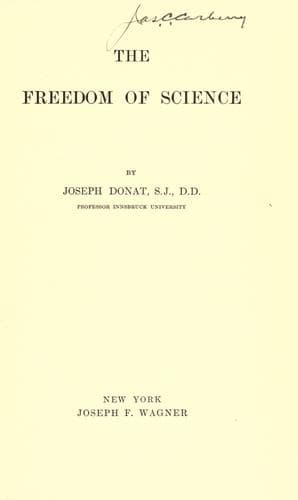
Free thought; Modernism (Christian theology) -- Catholic Church; Religion and science; Teaching, Freedom of
Of course, this is not the only authority. Even if a revelation from
heaven had not been given us, yet those _general convictions of mankind_,
common to all nations and times, of the immutability of the laws of
thought and morality, of the existence of a supramundane God, of the
retribution for moral conduct to be made in the world to come, of the
sanctity of state-authority, of the necessity of private property, and
others, would ever remain most revered utterances of truth. No one would
be allowed to contradict this avowal of all mankind, relying on his own
reasoning, which he calls science, and give the lie to the reasoning of
all other men, in order to make his own reason the sole measure of truth.
But for the present let us pass over the natural authority of mankind, of
its convictions and traditions. It is surpassed and replaced by the
_authority of faith_ which belongs to _our Christian religion_. The latter
comes to us claiming to possess the only true view of the world, and
laying upon us the obligation of accepting it. It has even the courage to
put its anathema upon propositions which the scientist may call science;
it dares write out a list of the propositions which it condemns as
untenable. Against this authority the protest is raised: Where is freedom
of research, if one cannot even indulge in his own ideas, if the intellect
is to be cropped and fettered? What is to become of frank, unprejudiced
investigation, if I am from the outset bound to certain propositions, if
from the outset the result at which I must arrive is already determined?
It is intellectual bondage that the man of faith is languishing in. Thus
reads the indictment; thus sounds the battle-cry. Is the indictment
justified? Can and shall science take faith as a guide in many instances
without detriment to its own innate freedom? And where, and when?
First, the more general question: Is freedom of research compatible with
the duty to believe, or do they exclude each other in principle?
What Faith is Not.
What, then, is faith, and what does the duty to believe demand of us?
Public-domain text, read in full here on John Shaqi.
Reviews
Reviews
No reviews yet
Be the first to share your thoughts on this work.
Join the Discussion
Join the discussion
Sign in to leave a comment or review.
Sign InorCreate an account