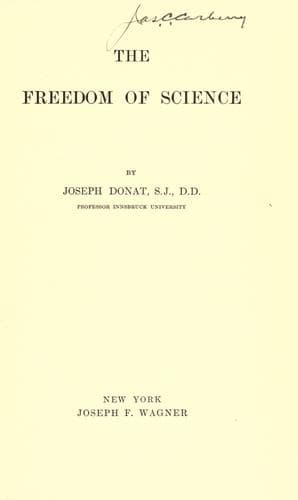
Free thought; Modernism (Christian theology) -- Catholic Church; Religion and science; Teaching, Freedom of
Thus the divine revelation and the Church approach all men with the duty
to believe: “he that believeth shall be saved,” God gravely commands; “and
if he will not hear the Church, let him be to thee as the heathen and
publican” (Matt. xviii. 17). They lay their teachings before the human
intellect, bidding it retain them as indubitable truth, upon their
infallible testimony, yet only after convincing itself that God has really
spoken, and that this Church is the true one, which cannot err. And only
after having convinced itself of the credibility of the proposed teaching
is it obliged to believe. Hence, according to the Christian mind, faith is
the _reasonable conviction of the truth of what is proposed for belief, by
reason of an acknowledged infallible testimony_.
The Catholic dogma we find explained in the definition of the
Vatican Council, which had to expose so many errors that are
liable in our days to confuse the faithful in their notions of
faith and Church. “This faith,” says the Vatican Council (Sess.
III, chap. 3), “which is the beginning of human salvation, the
Catholic Church teaches to be a supernatural virtue, by which,
through the inspiration and co-operation of the grace of God, we
believe to be true what He has revealed, not on account of the
intrinsic truth of it, perceived by the natural light of reason,
but on the authority of God who gives the revelation, who can
neither deceive nor be deceived.... Nevertheless, in order that
the service of our belief might be in accord with reason (‘a
reasonable service’) God willed to unite to the internal helps of
the Holy Ghost external proofs of His revelation, to wit, external
works divine, especially miracles and prophecies, which, clearly
demonstrating God’s omnipotence and infinite knowledge, are most
certain signs of divine revelation and are suited to the
intelligence of all.” The Council adds expressly the canon: “If
any one say that divine revelation cannot be made credible by
exterior signs, and that men ought therefore to be moved to belief
solely by their interior experience or individual inspiration, let
him be anathema.” We have here stated the Catholic dogma as
unanimously taught by all Christian centuries, by all Fathers and
theologians.
Public-domain text, read in full here on John Shaqi.
Reviews
Reviews
No reviews yet
Be the first to share your thoughts on this work.
Elsewhere in the archive
Join the Discussion
Join the discussion
Sign in to leave a comment or review.
Sign InorCreate an account