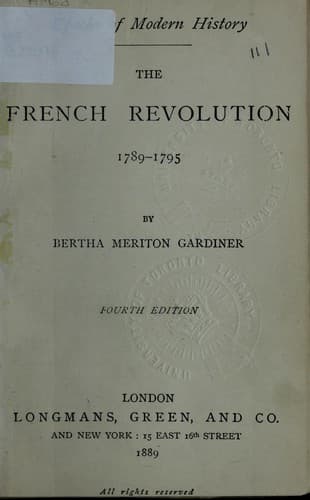
The French Revolution 1789-1795Gardiner, Bertha Meriton
History
The French Revolution 1789-1795
Gardiner, Bertha Meriton
France -- History -- Revolution, 1789-1799
A great revolution had indeed been accomplished. The fall of the
Bastille indicated the fall of the old monarchy, in which the King
alone represented the nation. Louis had said to the Assembly that,
unless he were obeyed, he would secure the happiness of his subjects
without its aid, and Paris had replied by rising in support of the
Assembly against himself. The falling away of the army had unmistakably
revealed his weakness and powerlessness to resist the national will.
His brother, the Count of Artois, and other unpopular courtiers, known
to be especially hostile to the people’s cause, fled the country
in disgust and alarm. Louis himself had no choice but to yield all
that was demanded of him. He ordered the withdrawal of the troops,
and recalled Necker to office. The Assembly sent eighty-eight of
its members to announce the good news to Paris. They were received
with enthusiasm, and escorted by thousands of national guards to
the Hôtel de Ville, where the electors exercised the functions of a
provisional municipality. Two deputies were singled out for special
honours. A young and popular nobleman, Lafayette, who had fought in
America against the English, and since the meeting of the Assembly had
supported the cause of the Third Estate, was by acclamation chosen
commander-in-chief of the new militia or national guard. Bailly, a
mathematician, who had been president of the Third Estate when the oath
was taken in the tennis court, was after the same fashion chosen mayor
of Paris. To the blue and red, the colours of Paris first worn by the
national guard, was subsequently, on Lafayette’s suggestion, added
white, the colour of France. This new flag would, he magniloquently
said, make the round of the world. Thus was instituted the famous
tricolour, the emblem to France of the revolution.
It only remained for Louis to recognise these new revolutionary
authorities, which made the capital of his kingdom independent of him
and of his government. Leaving the Queen weeping at Versailles in alarm
for his safety, he drove to Paris, attended merely by some members
of the Assembly and a few national guards. At the barrier of Passy,
the mayor, Bailly, presented him with the keys of the city, the same
which, on an occasion dissimilar to this had been presented to Henri
IV., when Paris had surrendered to him, ‘He,’ said Bailly to Louis,
‘had made conquest of his people. Now the people have made conquest of
their King.’ Arrived at the Hôtel de Ville, Louis fixed a tricolour
cockade on his hat and appeared on a balcony in front of the building.
The thousands assembled outside applauded him loudly, and shouts of
‘Vive le Roi’ mingled with shouts of ‘Vive la Nation.’ The enthusiasm
exhibited in his favour was not unreal. Amongst the multitude present,
no stronger desire existed than that of accomplishing the revolution in
accordance with the crown.
♦Risings in the provinces.♦
Public-domain text, read in full here on John Shaqi.
Reviews
Reviews
No reviews yet
Be the first to share your thoughts on this work.
Join the Discussion
Join the discussion
Sign in to leave a comment or review.
Sign InorCreate an account