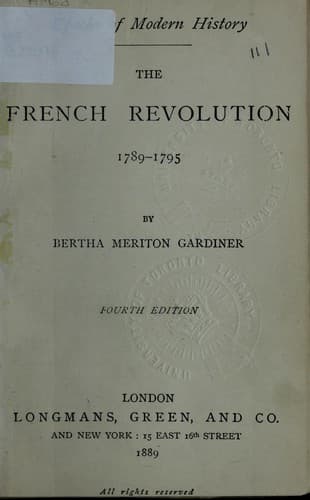
The French Revolution 1789-1795Gardiner, Bertha Meriton
History
The French Revolution 1789-1795
Gardiner, Bertha Meriton
France -- History -- Revolution, 1789-1799
While political strife was raging at Paris, in the provinces the
people, impatient for relief, were taking upon themselves the work of
redressing their wrongs. Since the meeting of the States riots had
broken out by scores over the face of the country. Taxes were refused,
barriers for the collection of custom and excise duties burnt, the
collectors driven off, markets pillaged, municipal officers forced at
peril of their lives to fix a price for corn and bread. The news of the
great insurrection of July 14 gave courage to agitators, and added fuel
to the flame. In Paris, street mobs, goaded by hunger, were not easily
restrained from hanging objects of suspicion on the nearest lamp-post.
Foulon, an officer of the Government, accused truly or falsely of
having said that the people if hungry might eat grass, was savagely
murdered. His son-in-law, Berthier, suffered a like fate. Many other
persons escaped but narrowly with their lives. Nevertheless, owing to
the exertions of the new municipality and the national guard, life
and property were more secure in the capital than in many provinces.
Risings accompanied by pillage and murder took place in Strasbourg,
Rouen, Besançon, Lyons, and other provincial towns. In the east,
through Alsace, Franche-Comté, Lorraine, Burgundy and Dauphiny, the
rural population sought to settle the question of feudal services by
burning together the residences and the title-deeds of the seigneurs.
In the Maconnais and Beaujolais, bands of peasants sacked and burned
seventy-two country-houses in a fortnight. A panic spread through
the country on the report that brigands, instigated by the enemies
of the revolution, were on the march to destroy the crops. A general
cry was raised for arms; the example set by Paris was followed; the
middle classes combined to restore order; provisional municipalities
were established and national guards instituted. The order obtained,
however, was still most precarious. Municipal officers were in constant
danger of falling victims to mob violence, while in country districts
national guards often made common cause with the rioters.
Thus the result of the insurrection of July 14, and of the risings in
the provinces, was the utter disorganisation of all the old machinery
of government. Royal officers where they remained could not exercise
authority. The army was in mutiny; the people were armed. New popular
authorities had, as it were, of themselves sprung up over the face of
the country, and the National Assembly, in place of the royal council,
became the centre of government, so far as any government existed.
♦Decrees of August 4.♦
Public-domain text, read in full here on John Shaqi.
Reviews
Reviews
No reviews yet
Be the first to share your thoughts on this work.
Join the Discussion
Join the discussion
Sign in to leave a comment or review.
Sign InorCreate an account