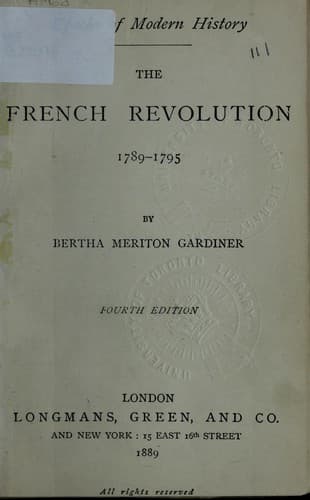
The French Revolution 1789-1795Gardiner, Bertha Meriton
History
The French Revolution 1789-1795
Gardiner, Bertha Meriton
France -- History -- Revolution, 1789-1799
The movement of October 6 was not, like the rising of July 14,
unpremeditated. The scarcity of bread had been made use of by agitators
to suggest to the populace the idea of bringing the King to Paris.
Their object was to place both the King and the Assembly immediately
under the influence of the capital. To the Duke of Orleans at the
time was ascribed the intention of driving the royal family from
Versailles, and obtaining for himself, if not the throne, a regency.
The Duke, unprincipled and of mean capacity, was incompetent, if he
had the ambition, to play a prominent part in the revolution. The
possession of great wealth assured him hangers-on and partisans, but
he was generally despised, and no man of any standing ever openly
espoused his cause. Deputies of the centre and left, as well as the
municipality and Lafayette, regarded the residence of the court at
Paris as security against attempts to raise civil war by the removal
of the King and the division of the Assembly. From this time the royal
family was in fact in the keeping of Lafayette, whose troops composed
the palace guard. The court could see nothing in the event but one more
act of popular violence, which must before long cause reaction. After
the fall of the Bastille, the King’s brother, the Count of Artois, had
left France. Many court nobles, including deputies of the reactionary
right, now took the same course, with full expectation of shortly
returning and finding the old order of things restored. Two leaders
of the right centre, Mounier and Lally-Tollendal, quitted the capital
on the plea that their lives were in danger, and that the Assembly
was not free. It was true that those who took the lead in defending
unpopular opinions were subject to menace and insult, but it was not
true that deputies sitting on the right were precluded from taking part
in the debates or voting according to their pleasure. On the contrary,
if the galleries were often noisy and abusive, bishops and nobles found
opportunities not only of replying at length to their opponents, but
also of obstructing proceedings for hours by mere clamour. The ordinary
form of voting, which was simply by rising and sitting, prevented the
frequent publication of division lists. Much important work, in which
all could take part in safety, was done in private committees, and
drafts of laws prepared in them were often adopted by the Assembly with
little alteration. The withdrawal of deputies only helped to complete
the disorganisation of an already divided minority.
♦The Jacobins.♦
Public-domain text, read in full here on John Shaqi.
Reviews
Reviews
No reviews yet
Be the first to share your thoughts on this work.
Elsewhere in the archive
Join the Discussion
Join the discussion
Sign in to leave a comment or review.
Sign InorCreate an account