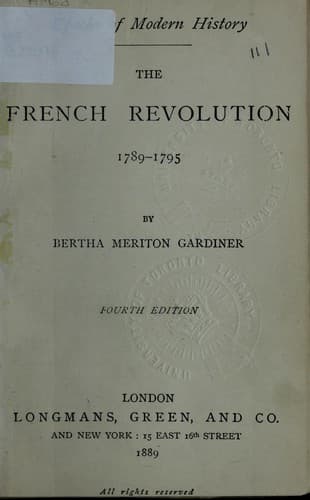
The French Revolution 1789-1795Gardiner, Bertha Meriton
History
The French Revolution 1789-1795
Gardiner, Bertha Meriton
France -- History -- Revolution, 1789-1799
a reformed system of taxation, a sum varying from eighteen pence to two
shillings, the value of three days’ labour. Manhood suffrage would
have given 6,000,000 voters, while this qualification limited their
number to about 4,300,000 only. Persons qualified to vote were required
to serve in the national guard, and were called active citizens, whilst
those disqualified were known as passive citizens. For the election
of the administrative bodies of the district and the department, as
well as of deputies to the legislature, the system adopted was by two
degrees. There were many primary assemblies, consisting of all active
citizens in each department, each of which chose a certain number
of electors, who in turn elected the administrative bodies of the
districts and of the department, as well as the deputies who were to
represent the department in the legislature. The qualification for
being a member of a municipality, or of any administrative body, was
the payment yearly in direct taxes of a sum varying from six to eight
shillings. A special and higher qualification was required for sitting
in the legislature--the payment in direct taxes of a marc, in value
nearly fifty shillings.
♦Judicial reform.♦
The new administrative divisions served as judicial divisions also.
The old courts, including the parliaments, were one after another
abolished. Each district was divided into cantons, and the primary
assemblies in each canton elected judges, called justices of the peace
(_juges de paix_), for the trial of petty causes. Every district
had a civil, every department a criminal court, of which the judges
were respectively elected by the electors of the district and the
department. Persons belonging to any branch of the legal profession
were eligible as judges, who were elected for six years only. Much
directly remedial legislation accompanied this new framework. Procedure
was rendered more favourable to the accused. Trial by jury on the
English system was adopted in criminal cases, every department having
its grand jury. Securities were taken against arbitrary arrest
and imprisonment, and the law was made the same for all, without
distinction of persons. A new penal code was drawn up which contrasted
most favourably with the criminal law in force in other countries.
Heresy and magic were no longer recognised as crimes. Torture was
abolished, and the punishment of death confined to four or five
offences.
♦Church property appropriated by the State.♦
Public-domain text, read in full here on John Shaqi.
Reviews
Reviews
No reviews yet
Be the first to share your thoughts on this work.
Elsewhere in the archive
Join the Discussion
Join the discussion
Sign in to leave a comment or review.
Sign InorCreate an account