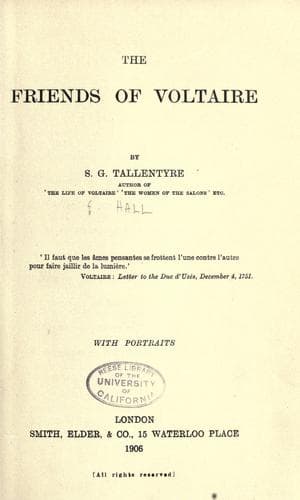
France -- Biography; Voltaire, 1694-1778 -- Friends and associates
Still, he gathered together the strength he had left him and the pluck
that never failed him, rejoined his regiment in Germany in 1743, fought
nobly for his fallen cause at Dettingen, and returned to the garrison of
Arras at the end of the year, an invalid for life.
It was now obvious he could no longer pursue his calling. Though he
wrote with a keen and bitter truth that courage had come to be regarded
as a popular delusion, patriotism as a prejudice, and that ‘one sees in
the army only disgust, _ennui_, neglect, murmuring; luxury and
effeminacy have produced the same effrontery as peace; and those who
should, from their position, arrest the progress of the evil, encourage
it by their example,’ yet still he would, if he could, have been soldier
to the end. For a time he thought of diplomacy. ‘Great positions soon
teach great minds,’ was one of his axioms. He would have been well
fitted. But merit was not of the slightest help to advancement. To fawn
on the King and the Mistress, to prostitute one’s life and one’s talents
to a Court--here was the way to promotion. Vauvenargues wrote to the
King and corresponded with Amelot the Minister, who answered most
amiably and affably--and did nothing at all. ‘Permit me, sir,’ wrote
Vauvenargues to him at last, with the directness taught in camps, ‘to
assure you that it is a moral impossibility for a gentleman, with
nothing but zeal to commend him, ever to reach the King.’ Amelot, stung
a little, promised the next vacant post, and this time promised
sincerely.
Vauvenargues retired to Provence and to quiet, to learn his new
business. There he was attacked by confluent small-pox, which left him
nearly blind and wholly disfigured: a misfortune he felt painfully as
‘one of those accidents which prevent the soul from showing itself.’ But
worse than any disfigurement, the partial blindness made, of course, a
diplomatic career an impossibility for ever.
Before the campaign of 1743, Vauvenargues had introduced himself to
Arouet de Voltaire, by a letter in which the obscure soldier-critic
compared Corneille disadvantageously with Racine. Nothing is so
delightful in Voltaire’s own genius as his generous recognition of other
men’s. Nothing is more to his honour than his high admiration for the
moral gifts of a Vauvenargues who was young enough to be his son, who
was poor, forlorn, a nobody, and whose fine qualities of lofty
highmindedness, delicacy, patience and serenity found, alas! no
counterpart in Voltaire’s own nature. It is so much the more to his
credit that he could admire what he could never imitate, and appreciate
what was wholly foreign to his temperament. He rejoiced in the
thoughtful ability of that letter. ‘It is the part of such a man as
you,’ he replied, ‘to have preferences but no exclusions.’
The campaign of 1743 had interrupted their relationship. But they
resumed it now, and, behold! it had turned into friendship.
Public-domain text, read in full here on John Shaqi.
Reviews
Reviews
No reviews yet
Be the first to share your thoughts on this work.
Join the Discussion
Join the discussion
Sign in to leave a comment or review.
Sign InorCreate an account