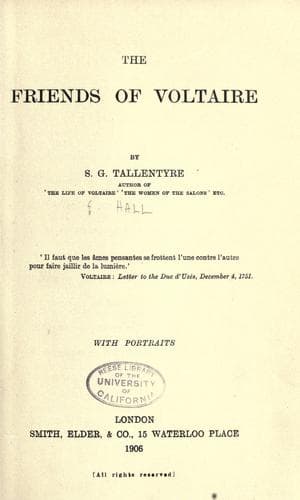
France -- Biography; Voltaire, 1694-1778 -- Friends and associates
Cousin Victor easily perceived that this thoughtful young soldier was
fitted for something widely different from the life of a garrison town.
Come up to Paris, then! Take up letters as a career! Win the smiles of
the Court, and a pension from the Privy Purse! But Vauvenargues not only
preferred literature to the sham called literary fame, but he loved his
own profession.
Thinker as nature had made him, thinker, moralist, aphorist as he has
come down the ages, he was first of all a man of action, and so sound in
thought because he was so strong in deeds. All his maxims were ‘hewn
from life.’ When the death of the Emperor Charles VI. in 1740 shook the
kingdoms of Europe as a child shakes its marbles in a bag, Luc de
Vauvenargues shouldered his knapsack and went out to Bohemia under the
command of Belle-Isle. Ready to dare and to do, brave, young,
high-spirited, knowing no career more glorious than arms, he looked
round him and drew from keen experience his views of the world.
The philosopher in a study, weighing the _pros_ and _cons_ of motives he
knows by hearsay, of deeds of which he has read, of passions he has
never felt, may be a very fine thinker, but will hardly be chosen as a
sound guide to practice.
The explorer who has faced the torrent and the mountain, the burning sun
of the desert, hunger and cold and thirst, who has himself fought with
beasts at Ephesus, will have a knowledge of the country he has
discovered, which no books and lectures, no geographical or
topographical knowledge can ever give to the cleverest student at home.
The worth and the use of Vauvenargues’ axioms on life lie largely in the
fact that _he had been there himself_.
The very brief triumph of the capture of Prague in 1742 was succeeded by
the horrors of the great mid-winter march from Prague to Egra. The
King’s Own suffered terribly. Death, defeat, famine, Vauvenargues knew
not as names but as realities. In the spring of 1742 he had lost a young
comrade, de Seytres, and wrote an _éloge_ of him. Its immature and
stilted style gives little idea of the warm feeling it clothed. Morley
speaks of Vauvenargues’ ‘patient sweetness and equanimity’ as a friend;
and records how hardship made him ‘not sour,’ but wise and tender. All
through that fearful march, in this strange soldier’s knapsack were the
manuscripts of ‘Discourses on Fame and Pleasure,’ ‘Counsels to a Young
Man,’ and a ‘Meditation on Faith.’ Of many of his maxims on patience and
the brave endurance of suffering, he must have found at this time cruel
personal need.
The handsome young officer who had left France in the prime of his hopes
and his manhood, returned to it with his health utterly ruined, both his
legs frost-bitten, and his lungs seriously affected.
Public-domain text, read in full here on John Shaqi.
Reviews
Reviews
No reviews yet
Be the first to share your thoughts on this work.
Join the Discussion
Join the discussion
Sign in to leave a comment or review.
Sign InorCreate an account