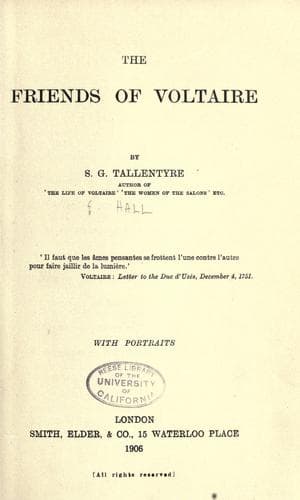
France -- Biography; Voltaire, 1694-1778 -- Friends and associates
Instead of mockery--the besetting sin of his generation--this man, and
this man alone, had for men’s follies and absurdities only infinite
compassion. Of him has been aptly quoted Bacon’s beautiful phrase, ‘he
had an aspect as though he pitied men.’ His philosophy remains for ever
to the unquiet heart at once balm and tonic--the cool hand of compassion
on the burning forehead--the touch of a friend, who knows--the strong
grasp of help to raise the feeble from his weakness and despair, and to
make him do what he can.
Some of the axioms have become part of men’s speech, if not part of
their soul.
‘Great thoughts come from the heart.’
‘We should comfort ourselves for not having fine talents, as we comfort
ourselves for not having fine positions; we can be above both by the
heart.’
‘Great men undertake great things because they are great, and fools
because they think them easy.’
‘Would you say great things? Then first accustom yourself never to say
false ones.’
‘Who can bear all, can dare all.’
‘Envy is confessed inferiority.’
‘Few sorrows are without remedy: despair is more deceptive than hope.’
‘Who gives his word lightly, breaks it.’
‘He who has great feeling, knows much.’
‘To the passions one owes the best things of the mind.’
Into that mad devotion to wit which was the snare of all his compeers,
Vauvenargues never fell. He worshipped at the shrine of a diviner
goddess called Truth. There is not a single example--even in his maxims,
when the temptation would naturally be strongest--of his sacrificing
fidelity to smartness.
In February 1746, after he had been less than a year in Paris, he
published anonymously that book by which he has gone down the ages and
up to the gods, and which contains only the ‘Introduction to the
Knowledge of the Human Mind,’ some ‘Reflections,’ the ‘Counsels to a
Young Man,’ a few critical articles, the ‘Meditation on Faith,’ and the
‘Maxims.’
Clear, clean, and vigorous in style, as sharp and brief as a military
order--it was well said by a friend that its author ‘wanted first of all
to get along quickly and drag little baggage after him;’ and better
said by himself that, ‘when an idea will not bear a simple form of
expression, it is the sign for rejecting it.’
It was not the sort of work likely to bring him present fame, or money.
He did not expect them. As he worked in his miserable lodgings, ill lit
and ill warmed, already a prey to consumption, and suffering often
acutely from the old frost-bites--no such hopes had buoyed him. But he
did what he had told other men to do--worked for the work’s sake--and he
found what he had told them they would find, joy in the working and
satisfaction in a noble aim, be it unrewarded for ever.
Public-domain text, read in full here on John Shaqi.
Reviews
Reviews
No reviews yet
Be the first to share your thoughts on this work.
Join the Discussion
Join the discussion
Sign in to leave a comment or review.
Sign InorCreate an account