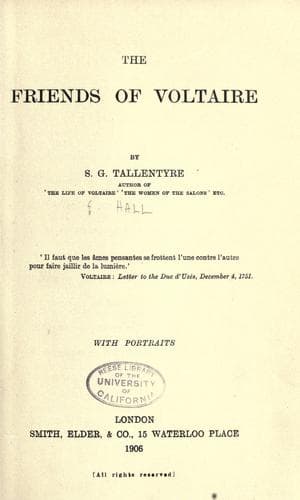
France -- Biography; Voltaire, 1694-1778 -- Friends and associates
In the very heart and core of Paris, Rue Royale _butte_ Saint-Roch, the
Baron held in his town house what Rousseau calls the ‘club holbachique,’
Diderot ‘the synagogue of the Rue Royale,’ and Garat ‘the Institute of
France before there was one.’ Here, at two o’clock every Sunday and
Thursday, unless the d’Holbachs were in the country, their friends were
certain to find a free and affluent hospitality, the most intellectual
society of the capital, the most distinguished foreigners who visited
it, a host as liberal in idea as in the very good cheer to which he made
his guests welcome, and the most daring speculative conversation of the
eighteenth century.
But, after all, it was not in the Rue Royale that d’Holbach and his
friends found their most characteristic setting. Grandval, near
Charenton, remains not only the most influential _salon_ of the age, the
great headquarters of a great party and the arsenal in which were forged
the armaments which destroyed a king, a dynasty, and a state religion,
but also _the_ country house of the period.
When Talleyrand, in that much quoted phrase, declared that no one knew
how delightful a thing life could be unless he had belonged to the upper
classes before the Revolution, he might have been thinking of the life
at Grandval in particular.
There was a fine and charming _château_, and the most delightful of
gardens. Grandval was just near enough to Paris, and just far enough
away--which is to say, it was absolute country, within easy reach of
town, in an age when the suburb was not, or, at least, when the social
drawbacks comprehended in the word ‘suburban’ had no existence. The
estate actually belonged to Madame d’Aine, d’Holbach’s mother-in-law,
who was as ‘lively as any romp of fifteen,’ always thoroughly enjoying
herself, determined her guests should do the same, and with the rare
wisdom to leave them to do it in their own way.
Madame d’Holbach was pretty, gay, and charming. She played on the lute,
adored her husband and children, and hated philosophy. If her guests
like to talk it--and they are always talking it--well, by all means, so
they shall! Live and let live, do as you like come what may--these would
have been the Grandval rules, if it had ever bothered itself to have
anything so tiresome as rules.
The d’Holbach children were adorable--or despatched to governesses and
servants if they even threatened to become less than adorable. There
were two little boys and a couple of little girls, the elder ‘as pretty
as a cherub,’ said Diderot, and the younger ‘a ball of fat, all pink and
white.’
Public-domain text, read in full here on John Shaqi.
Reviews
Reviews
No reviews yet
Be the first to share your thoughts on this work.
Elsewhere in the archive
Join the Discussion
Join the discussion
Sign in to leave a comment or review.
Sign InorCreate an account