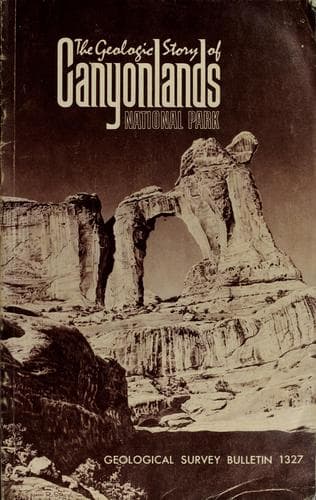
The Geologic Story of Canyonlands National ParkLohman, Stanley William
Science
The Geologic Story of Canyonlands National Park
Lohman, Stanley William
Canyonlands National Park (Utah) -- Guidebooks; Geology -- Utah -- Canyonlands National Park -- Guidebooks
A glance at the southeast corner of the map (fig. 1) shows that most of
the arches and prehistoric ruins in the park are in Salt Canyon and its
main tributary, Horse Canyon. A few are in adjacent Davis and Lavender
Canyons, whose headwaters were recently annexed to the park. These
canyons are accessible only by negotiating the streambeds on
four-wheel-drive vehicles, horseback, or foot. Salt or Horse Canyons are
best conquered by four-wheel-drive vehicles plus short hikes in the
northern part and long hikes in the southern part.
An aerial view (fig. 40) eastward across Salt Canyon shows that erosion
has produced an intricate series of meandering canyons separated by
rather narrow walls of the Cedar Mesa Sandstone, resembling somewhat The
Maze, west of the Green River.
[Illustration: AERIAL VIEW EASTWARD ACROSS SALT CANYON. Note narrow
walls and pinnacles between canyons and alcoves. Six-Shooter Peaks
are in left background. Photograph by Wayne Alcorn, National Park
Service. (Fig. 40)]
The massive sandstone beds of the Cedar Mesa are composed of sand grains
cemented together by calcium carbonate (CaCO₃), which also forms the
mineral called calcite and the rock known as limestone. Limestone and
calcite are soluble in acid, even weak acid such as carbonic acid
(H·HCO₃), formed by solution of carbon dioxide (CO₂) in water. Ground
water, found everywhere in rock openings at differing depths beneath the
surface, contains considerable dissolved carbon dioxide derived from
decaying organic matter in soil, from the atmosphere, and from other
sources. Even rain water and snow contain small amounts absorbed from
the atmosphere—enough to dissolve small amounts of limestone or of
calcite cement in sandstone. The calcite cement in the Cedar Mesa and
many other sandstones is unevenly distributed, so the cement is removed
first from places that contain the least amounts, and once the cement is
dissolved, the loose sand grains are carried away by gravity, wind, or
water. Thus, relatively thin walls of sandstone containing irregularly
distributed patches of soluble cement are prime targets for the
formation of potholes (fig. 46), alcoves, and caves. Once a breakthrough
occurs, weakened chunks from the ceiling tend to fall off, and arches of
various shapes are produced, because an arch is naturally the strongest
form that can support the overlying rock load. Man, from the ancient
Greeks, Romans, and Egyptians to modern day, has long made use of arches
in building bridges, aqueducts, temples, cathedrals, and other enduring
edifices. All the spectacular arches we are about to see were carved
from the Cedar Mesa Sandstone.
Public-domain text, read in full here on John Shaqi.
Reviews
Reviews
No reviews yet
Be the first to share your thoughts on this work.
Join the Discussion
Join the discussion
Sign in to leave a comment or review.
Sign InorCreate an account