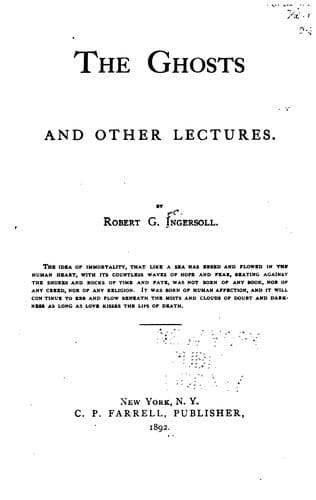
The Ghosts, and Other LecturesIngersoll, Robert Green
Religion
The Ghosts, and Other Lectures
Ingersoll, Robert Green
Free thought
The old way of farming was a great mistake. Everything was done the
wrong way. It was all work and waste, weariness and want. They used
to fence a hundred and sixty acres of land with a couple of dogs.
Everything was left to the protection of the blessed trinity of chance,
accident and mistake.
When I was a farmer they used to haul wheat two hundred miles in wagons
and sell it for thirty-five cents a bushel. They would bring home about
three hundred feet of lumber, two bunches of shingles, a barrel of salt,
and a cook-stove that never would draw and never did bake.
In those blessed days the people lived on corn and bacon. Cooking was
an unknown art. Eating was a necessity, not a pleasure. It was hard work
for the cook to keep on good terms even with hunger.
We had poor houses. The rain held the roofs in perfect contempt, and
the snow drifted joyfully on the floors and beds. They had no barns. The
horses were kept in rail pens surrounded with straw. Long before spring
the sides would be-eaten away and nothing but roofs would be left. Food
is fuel. When the cattle were exposed to all the blasts of winter, it
took all the corn and oats that could be stuffed into them to prevent
actual starvation.
In those times most farmers thought the best place for the pig-pen was
immediately in front of the house. There is nothing like sociability.
Women were supposed to know the art of making fires without fuel. The
wood pile consisted, as a general thing, of one log upon which an axe or
two had been worn out in vain. There was nothing to kindle a fire with.
Pickets were pulled from the garden fence, clap-boards taken from the
house, and every stray plank was seized upon for kindling. Everything
was done in the hardest way. Everything about the farm was disagreeable.
Nothing was kept in order. Nothing was preserved. The wagons stood
in the sun and rain, and the plows rusted in the fields. There was
no leisure, no feeling that the work was done. It was all labor and
weariness and vexation of spirit. The crops were destroyed by wandering
herds, or they were put in too late, or too early, or they were blown
down, or caught by the frost, or devoured by bugs, or stung by flies,
or eaten by worms, or carried away by birds, or dug up by gophers, or
washed away by floods, or dried up by the sun, or rotted in the stack,
or heated in the crib, or they all run to vines, or tops, or straw, or
smut, or cobs. And when in spite of all these accidents that lie in wait
between the plow and the reaper, they did succeed in raising a good crop
and a high price was offered, then the roads would be impassable. And
when the roads got good, then the prices went down. Everything worked
together for evil.
Public-domain text, read in full here on John Shaqi.
Reviews
Reviews
No reviews yet
Be the first to share your thoughts on this work.
Join the Discussion
Join the discussion
Sign in to leave a comment or review.
Sign InorCreate an account