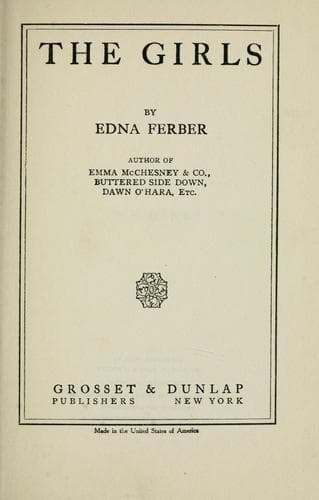
Chicago (Ill.) -- Fiction; Families -- Fiction; Women -- Fiction; World War, 1914-1918 -- Fiction
Lottie would look ruefully down her own length, a mischievous smile
crinkling the corners of her eyes. "And I thought I looked so nice! Not
chic, perhaps, but nice!" Her slim, well-shod feet, her neat silken
ankles, her sensible skirt, her collars and cuffs, or blouses and
frills were always so admirably trim, so crisply fresh where freshness
was required. Looking at her you had such confidence in the contents of
her bureau drawers.
"Oh--nice! Who wants to look nice, nowadays!"
Mrs. Payson always insisted on talking business with her courteous but
palpably irked son-in-law. Her views and methods were not his. When, in
self-defense, he hinted this to her she resented it spiritedly with,
"Well, I ran a successful business and supported a household before you
had turned your first dollar, Henry Kemp. I'm not a fool."
"I should think not, Mother Payson. But things have changed since your
time. Methods."
He knew his wife was tapping a meaningful foot; and that Charley's
mischievous intelligent eyes held for him a message of quick
understanding and sympathy. Great friends, he and Charley, though in
rare moments of anger he had been known to speak of her to his wife as
"your daughter."
Mrs. Payson was always ready with a suggestion whereby Henry Kemp
could improve his business. Henry Kemp's business was that of
importing china, glassware, and toys. Before the war he had been on
the road to a more than substantial fortune. France, Italy, Bohemia,
and Bavaria meant, to Henry Kemp, china from Limoges; glassware
from Venice and Prague; toys from Nürnberg and Munich. But Zeppelin
bombs, long-distance guns, and U-boats had shivered glass, china,
and toys into fragments these two years past. The firm had turned to
America for these products and found it sadly lacking. American dolls
were wooden-faced; American china was heavy, blue-white; American
glass-blowing was a trade, not an art. Henry Kemp hardly dared think of
what another year of war would mean to him.
Lottie thought of these things as the Indiana Avenue car droned along.
Her nerves were pushing it vainly. She'd be terribly late. And she
had told Hulda that she'd be home in time to beat up the Roquefort
dressing that Henry liked. Oh, well, dinner would be delayed a few
minutes. Anyway, it was much better than dinner alone with mother and
Aunt Charlotte. Dinner alone with mother and Aunt Charlotte had grown
to be something of a horror. Lottie dreaded and feared the silence that
settled down upon them. Sometimes she would realize that the three of
them had sat almost through the meal without speaking. Lottie struggled
to keep up the table-talk. There was something sodden and deadly about
these conversationless dinners. Lottie would try to chat brightly
about the day's happenings. But when these happenings had just been
participated in by all three, as was usually the case, the brightness
of their recounting was likely to be considerably tarnished.
Public-domain text, read in full here on John Shaqi.
Reviews
Reviews
No reviews yet
Be the first to share your thoughts on this work.
Join the Discussion
Join the discussion
Sign in to leave a comment or review.
Sign InorCreate an account