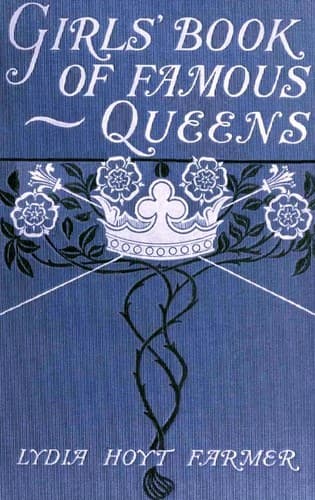
The Girls' Book of Famous QueensFarmer, Lydia Hoyt
History
The Girls' Book of Famous Queens
Farmer, Lydia Hoyt
Queens -- Biography -- Juvenile literature
Meanwhile, Antony was spending his time in Egypt. At length he
determined to undertake an expedition against the Parthians and
Armenians. While in Phœnicia, Cleopatra joined him, bringing him money
and clothes and food for his soldiers. Meanwhile Octavia had also
left Rome and reached Athens, on her way to Antony’s camp, to bring
him the supplies and money she had procured in Rome for his suffering
troops. Fearing that Octavia might win Antony from her side, Cleopatra
affected to die for love of him. She refrained from food, and was often
discovered by him in tears; and her attendants constantly reminded him
of her great grief, and declared that if he should leave her, she would
surely die. As Antony had married Octavia only for political power in
Rome, and as he did love Cleopatra more intensely than he had ever
loved any human being before, he sent word to Octavia to return to
Rome, and soon after sent deputies to Rome, to declare his divorce from
Octavia, and with orders to command her to leave his house, with all
her children.
Even this wicked and cruel indignity did not destroy the devoted love
of Octavia. She obeyed the outrageous summons, and continued to take
the most untiring care, not only of her own children, but of those of
Antony and his former wife, Fulvia. She also endeavored to appease the
indignation of the Roman people against him; but she could not lessen
the resentment of her brother Octavius, who now prepared for open war.
While the names of Antony and Cleopatra were held in abhorrence in
Rome, in Alexandria new and most gorgeous honors were accorded them.
In the magnificent palace of the Ptolemies a massive throne of gold was
erected, the ascent to which was by steps of solid silver. Upon this
glistening throne sat Antony and Cleopatra. He was arrayed in a superb
robe of purple, embroidered with gold, and buttoned with flashing
diamonds. On his side he wore a Persian scimitar, the handle and sheath
of which were encrusted with sparkling gems. His diadem glittered with
precious stones, and in his right hand he held a sceptre of gold. Thus
had he caused himself to be so gorgeously attired, in order, as he
said, “that in such royal equipage he might deserve to be the husband
of a queen.”
Public-domain text, read in full here on John Shaqi.
Reviews
Reviews
No reviews yet
Be the first to share your thoughts on this work.
Elsewhere in the archive
Join the Discussion
Join the discussion
Sign in to leave a comment or review.
Sign InorCreate an account