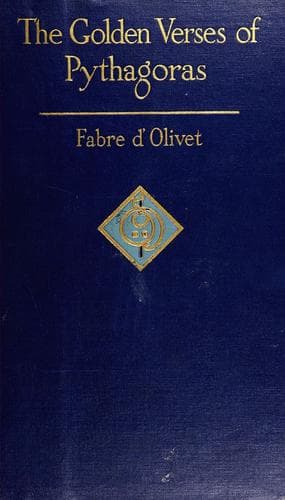
The golden verses of PythagorasFabre d'Olivet, Antoine
Religion
The golden verses of Pythagoras
Fabre d'Olivet, Antoine
Poetry -- History and criticism; Pythagoras and Pythagorean school
Arms and the man I sing, who first,
By fate of Ilium realm amerced,
To fair Italia onward bore,
And landed on Lavinium’s shore:――
Long tossing earth and ocean o’er,
By violence of heaven, to sate
Fell Juno’s unforgetting hate:
Much laboured too in battle-field,
Striving his city’s walls to build,
And give his Gods a home:
Thence come the hardy Latin brood,
The ancient sires of Alba’s blood,
And lofty-rampired Rome.
Say, Muse, for godhead how disdained,
Or wherefore worth, Heaven’s queen constrained
That soul of piety so long
To turn the wheel, to cope with wrong.
Can heavenly natures nourish hate
So fierce, so blindly passionate?
CONINGTON.
Arma virumque cano, Trojæ qui primus ab oris
Italiam, fato profugus, Lavinaque venit
Litora, multum ille et terris jactatus et alto
Vi superûm, sævæ memorem Junonis ob iram,
Multa quoque et bello passus, dum conderet urbem
Inferretque deos Latio: genus unde Latinum,
Albanique patres atque altæ mœnia Romæ.
Musa, mihi causas memora, quo numine læso,
Quidve dolens, regina deûm tot volvere casus
Insignem pietate virum, tot adire labores
Impulerit. Tantæne animis cœlestibus iræ?
It can be observed that Vergil, although he places himself foremost
and although he says, _I sing_, begins nevertheless in a manner much
less animated, much less sure than the Greek poet, who, transported
beyond himself, seems to impose upon his Muse the subject of his
songs, interrogates her, and then inspired by her, responds. The Latin
poet finishes, like his model, with a sentence; but it is easy to feel
that this apostrophe,
Can heavenly natures nourish hate
So fierce, so blindly passionate?
although very beautiful, contains less depth, less feeling, and holds
less intimately to the subject than this sublime reflection:
... and the men were perishing!
Someone has said that Vergil had imitated in his exposition the
commencement of the _Odyssey_ of Homer; this is a mistake. One finds
always in the exposition of the _Odyssey_ the real character of a
first inspiration blended with the invocation, although more calm and
less alluring than in the _Iliad_. Here is the translation:
Du plus sage Héros, Muse, dis les traverses
Sans nombre, après qu’il eut triomphé d’Ilion:
Rapelle les cités, les peuples, les usages,
Qu’il connut, et les mers où longtemps il erra:
À quels soins dévorants, à quels maux l’exposèrent
L’amour de la patrie et noble désir
D’y mener ses guerriers! Vain désir: ils osèrent,
Insensés! du Soleil dévorer les troupeaux;
Et ce Dieu, du retour leur ravit la journée.
Fais-nous part de ces faits, fille de Jupiter.
Public-domain text, read in full here on John Shaqi.
Reviews
Reviews
No reviews yet
Be the first to share your thoughts on this work.
Elsewhere in the archive
Join the Discussion
Join the discussion
Sign in to leave a comment or review.
Sign InorCreate an account