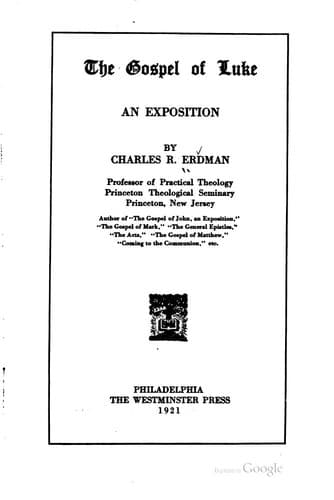
The Gospel of Luke, an expositionErdman, Charles Rosenbury
Religion
The Gospel of Luke, an exposition
Erdman, Charles Rosenbury
Bible. Luke -- Commentaries
This claim at once aroused the bitter resentment of the scribes and
Pharisees who were present and they began to reason: “Who is this that
speaketh blasphemies? Who can forgive sins, but God alone?” Their
reasoning was correct. Jesus was a blasphemer worthy of death, or else he
was divine.
To prove his deity Jesus proposed an immediate test: “Which is easier, to
say, Thy sins are forgiven thee; or to say, Arise and walk?” Of course
neither is easier; either requires divine power. Therefore, when at the
word of Jesus the man arose and started for his home, “glorifying God,” it
is not strange that “amazement took hold on all, and they glorified God.”
Thus the miracles of Christ were real proofs of his deity as well as
expressions of his love; they were moreover parables of his ability and
willingness to deliver man from the guilt and power of sin.
4. The Call of Levi. Ch. 5:27-32
27 And after these things he went forth, and beheld a publican,
named Levi, sitting at the place of toll, and said unto him,
Follow me. 28 And he forsook all, and rose up and followed him.
29 And Levi made him a great feast in his house: and there was a
great multitude of publicans and of others that were sitting at
meat with them. 30 And the Pharisees and their scribes murmured
against his disciples, saying, Why do ye eat and drink with the
publicans and sinners? 31 And Jesus answering said unto them, They
that are in health have no need of a physician; but they that are
sick. 32 I am not come to call the righteous but sinners to
repentance.
Nothing could further emphasize the sympathy of Jesus than his calling a
publican to be his close companion and friend. These taxgatherers were
everywhere despised for their dishonesty, extortion, and greed; but Jesus
chose one of them named Levi, or Matthew, and transformed him into an
apostle, an evangelist, and a saint.
There must have been something admirable in the character of the man; at
least there was something inspiring in his example, for as soon as he
heard the clear call of the Master, “He forsook all, and rose up and
followed him.”
Probably he had more to leave than any of the twelve men who became
apostles of Christ. He must have been possessed of wealth. At least, as
soon as he was converted, he made “a great feast in his house” and invited
“a great multitude of publicans and of others” to be his guests. He had
the courage of his convictions; he was not ashamed of his new Master. He
was eager to have his old friends introduced to Christ.
Public-domain text, read in full here on John Shaqi.
Reviews
Reviews
No reviews yet
Be the first to share your thoughts on this work.
Join the Discussion
Join the discussion
Sign in to leave a comment or review.
Sign InorCreate an account