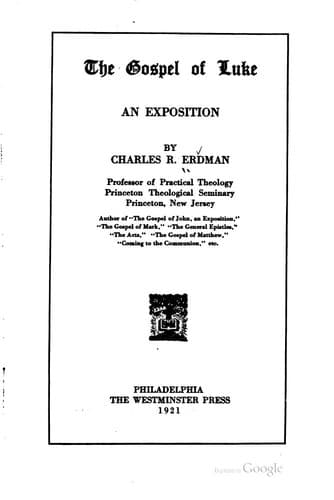
The Gospel of Luke, an expositionErdman, Charles Rosenbury
Religion
The Gospel of Luke, an exposition
Erdman, Charles Rosenbury
Bible. Luke -- Commentaries
It was on the occasion of this feast that Jesus was criticized by the
Pharisees for eating and drinking with publicans and sinners. He made this
most significant reply: “They that are in health have no need of a
physician; but they that are sick. I am not come to call the righteous but
sinners to repentance.” By this statement Jesus emphasized and vindicated
his conduct and defined his mission. A physician enters a sick room, not
because he delights in disease or rejoices in suffering, but because he
desires to cure and to relieve; so Jesus companied with sinners not
because he countenanced sin or enjoyed the society of the depraved, but
because, as a healer of souls, he was willing to go where he was most
needed and to work where the ravages of sin were most severe. He came into
the world to save sinners. Their conduct distressed him, their sins pained
him; but to accomplish his task he sought them out and showed his sympathy
by his presence and by his healing power.
Are there any who do not need the spiritual cure he can effect? Are any
“sound;” are some not “sinners”? These questions each must answer for
himself. Probably those who like the Pharisees are least conscious of
their sickness are in most desperate danger. Then again, are those who
know his power willing like the Master to go with his gospel to the places
of greatest need?
5. The Question of Fasting. Ch. 5:33-39
33 And they said unto him, The disciples of John fast often, and
make supplications; likewise also the _disciples_ of the
Pharisees; but thine eat and drink. 34 And Jesus said unto them,
Can ye make the sons of the bride-chamber fast, while the
bridegroom is with them? 35 But the days will come; and when the
bridegroom shall be taken away from them, then will they fast in
those days. 36 And he spake also a parable unto them: No man
rendeth a piece from a new garment and putteth it upon an old
garment; else he will rend the new, and also the piece from the
new will not agree with the old. 37 And no man putteth new wine
into old wine-skins; else the new wine will burst the skins, and
itself will be spilled, and the skins will perish. 38 But new wine
must be put into fresh wine-skins. 39 And no man having drunk old
_wine_ desireth new; for he saith, The old is good.
Public-domain text, read in full here on John Shaqi.
Reviews
Reviews
No reviews yet
Be the first to share your thoughts on this work.
Join the Discussion
Join the discussion
Sign in to leave a comment or review.
Sign InorCreate an account