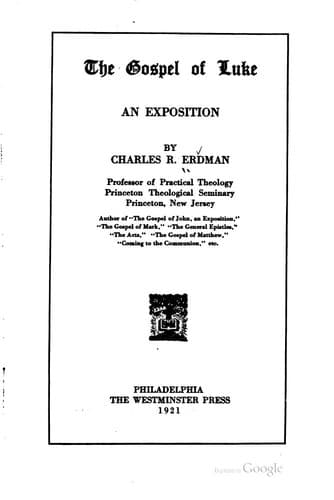
The Gospel of Luke, an expositionErdman, Charles Rosenbury
Religion
The Gospel of Luke, an exposition
Erdman, Charles Rosenbury
Bible. Luke -- Commentaries
12 And it came to pass in these days, that he went out into the
mountain to pray; and he continued all night in prayer to God. 13
And when it was day, he called his disciples; and he chose from
them twelve, whom also he named apostles: 14 Simon, whom he also
named Peter, and Andrew his brother, and James and John, and
Philip and Bartholomew, 15 and Matthew and Thomas, and James _the
son_ of Alphæus, and Simon who was called the Zealot, 16 and Judas
_the son_ of James, and Judas Iscariot, who became a traitor; 17
and he came down with them, and stood on a level place, and a
great multitude of his disciples, and a great number of the people
from all Judæa and Jerusalem, and the sea coast of Tyre and Sidon,
who came to hear him, and to be healed of their diseases; 18 and
they that were troubled with unclean spirits were healed. 19 And
all the multitude sought to touch him; for power came forth from
him, and healed _them_ all.
The choice of the twelve apostles marks a new and important period in the
public ministry of our Lord. The deep significance of the act is indicated
by Luke in his statement that Jesus passed the entire preceding night in
prayer to God. One reason for his decision may have been the mad hatred of
the Pharisees whose anger had now reached a murderous height. To give more
assured permanence to his work Jesus saw the necessity of organizing his
followers. He had been surrounded by a multitude of disciples, some of
whom were his constant companions, but he now determined to appoint
officers who would act as trained leaders, who would be his official
messengers accredited by miraculous powers.
In all four places in the New Testament where the names of these twelve
apostles are found, they are arranged in three invariable groups, possibly
in accordance with their intimacy with Jesus and their real service to
him. In all ages there have been among his followers such concentric
circles, such inner groups, who have been blessed by peculiar intimacy
with their Lord, not due to his arbitrary choice, but to their peculiar
capacities for love and obedience and faith.
The first six mentioned by Luke were men who under the influence of John
the Baptist had become the first followers of Christ. Other things being
equal, those who have known Jesus longest are able to serve him best.
The chief place in the first group is always assigned to Simon Peter,
bold, impulsive, fickle, but possessing the peculiar powers of leadership
which qualified him for the place of primacy among the apostles of our
Lord.
With him Luke names his brother Andrew, probably a man of less ability and
strength, but one who will ever be remembered as having brought Peter into
fellowship with Jesus. None can ever tell what share in the reward of a
more famous worker will be enjoyed by one more obscure to whom the greater
leader owes his Christian career.
Public-domain text, read in full here on John Shaqi.
Reviews
Reviews
No reviews yet
Be the first to share your thoughts on this work.
Elsewhere in the archive
Join the Discussion
Join the discussion
Sign in to leave a comment or review.
Sign InorCreate an account