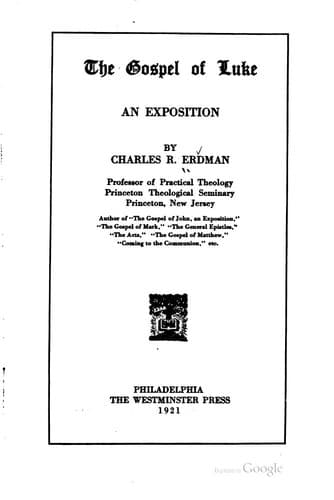
The Gospel of Luke, an expositionErdman, Charles Rosenbury
Religion
The Gospel of Luke, an exposition
Erdman, Charles Rosenbury
Bible. Luke -- Commentaries
If this address is the same as the Sermon on the Mount, it is to be noted
that each account begins with beatitudes and closes with a warning, while
the main body of the discourse differs only in the aspect of truth
emphasized by the two writers. In Matthew the essence of the Christian
life is described as true righteousness in distinction from the formalism
of the Pharisees. In Luke the essence of righteousness is found in love.
Matthew was writing with Jewish Christians in mind. The Gospel of Luke was
for the world and many of his readers would not have appreciated the
distinction which Matthew was emphasizing. The word which would describe
the sermon as recorded by Matthew is spirituality, but the substance of
the Christian life as here indicated by Luke is charity.
The Beatitudes here recorded are four in number, while Matthew mentions
eight or nine; but Luke adds four woes, each one of which is in striking
contrast with the parallel Beatitude, vs. 20-26. The sermon begins,
therefore, by pronouncing blessings upon the followers of Christ and
contrasted woes upon those who reject him. Those who are declared to be
blessed are the poor, the hungry, the mourners, and the despised; while
woes are pronounced upon the rich, the satisfied, the joyous, and the
praised. It is, of course, understood that there are spiritual
implications in these different terms. Poverty, hunger, sorrow, reproach,
have no merit in themselves and issue in present and eternal blessedness
only when accompanied by humility, trust, and patience, and when endured
for the sake of Christ. So, too, there is no wrong in riches and
satisfaction and laughter and praise unless these are accompanied by the
selfishness and greed and frivolity and unworthiness with which they are
so often identified. By these blessings and woes the Master indicated the
real character as well as the abiding blessedness of those who are his
true disciples.
The burden of the discourse, vs. 27-45, sets forth the Christian life as
being in essence a life of love. This sermon on love might be accompanied
properly by the “hymn of love” composed by Paul, 1 Cor., ch. 13, and by
the “Scripture lesson” on love written by John, 1 John 4:7-21.
First then, in place of all revenge, vs. 27-30, Jesus established the
Golden Rule: “As ye would that men should do to you, do ye also to them
likewise.” V. 31. Then, in contrast with the self-interest and desire for
recompense which so often passes among men as charity, vs. 32-34, he
pointed to the perfect example of God and intimated that his mercy should
incline us to kindly judgments of our fellows, assuring us of the
boundless liberality with which our Father will reward our unselfish love.
Vs. 35-38.
Public-domain text, read in full here on John Shaqi.
Reviews
Reviews
No reviews yet
Be the first to share your thoughts on this work.
Elsewhere in the archive
Join the Discussion
Join the discussion
Sign in to leave a comment or review.
Sign InorCreate an account